
5 Effective Exercises to Help Relieve Shoulder Pain and Improve Movement
Shoulder pain can make even simple daily activities difficult. Reaching for something on a shelf, combing your hair, wearing a shirt, lifting your arm or sleeping on one side can become uncomfortable. For some people, shoulder pain is temporary and improves with appropriate movement and rest. For others, it may be related to a condition such as frozen shoulder, rotator cuff injury, shoulder arthritis, shoulder instability or another shoulder problem.

Gentle exercises may help improve shoulder movement, reduce stiffness and support recovery in suitable cases. However, shoulder exercises are not a substitute for diagnosis. The correct exercise depends on the underlying cause of your pain.
In this guide, we explain 5 effective exercises to help relieve shoulder pain that are commonly used to encourage gentle movement and flexibility:
- Pendulum Stretch
- Doorway Chest & Shoulder Stretch
- Across-the-Chest Stretch
- Shoulder Blade Squeezes
- Child’s Pose Stretch
If your shoulder pain is persistent, severe, getting worse or affecting your daily activities, it is important to consult an experienced shoulder specialist in Nagpur for proper assessment.
At London Orthopaedic Clinic, Dr. Vishal Sahni provides specialist care for shoulder, elbow and wrist conditions, including shoulder injuries, rotator cuff problems, frozen shoulder, shoulder dislocation and shoulder arthritis.
Why Does Your Shoulder Hurt?
The shoulder is a highly mobile joint. It allows your arm to move in many directions, but this flexibility also means that the shoulder can be affected by different types of injuries and conditions.

Common reasons for shoulder pain include:
- Muscle or tendon strain
- Rotator cuff injury
- Rotator cuff tear
- Frozen shoulder
- Shoulder impingement
- Shoulder instability
- Shoulder dislocation
- Shoulder arthritis
- Sports injuries
- Previous shoulder injury or surgery
- Stiffness after prolonged immobilisation
Sometimes, shoulder pain develops gradually without one obvious injury. Other times, it starts suddenly after a fall, sports activity, lifting something heavy or an accident.
For example, a person with a rotator cuff tear may experience pain while lifting the arm, whereas someone with frozen shoulder may have significant stiffness and difficulty moving the arm in several directions.
This is why finding the actual cause is important before starting an aggressive exercise programme.
Can Exercises Help Shoulder Pain?
Yes, gentle shoulder exercises can help some people improve movement and flexibility, particularly when stiffness is contributing to symptoms.
Range-of-motion exercises are commonly used as part of management for conditions such as frozen shoulder. Healthcare professionals may also recommend personalised exercises during recovery from certain shoulder injuries.
However, there is an important difference between gentle movement and forcing a painful shoulder.
The aim is not to push through severe pain. Exercises should be controlled and comfortable. If an exercise significantly increases your pain, causes weakness, numbness, tingling or makes your symptoms worse afterwards, stop and seek professional advice.
5 Effective Exercises to Help Relieve Shoulder Pain
1. Pendulum Stretch
The pendulum stretch is a gentle movement that allows the arm to move without requiring the shoulder muscles to work heavily.
It is often used to encourage gentle shoulder movement, particularly when active movement is uncomfortable.
How to do the pendulum stretch
- Stand beside a stable chair or table.
- Place your comfortable hand on the chair or table for support.
- Bend slightly forward from your waist.
- Allow the painful arm to hang down naturally.
- Keep the shoulder relaxed.
- Gently move the arm forwards and backwards.
- You can also make small, gentle circles.
- Keep the movement slow and controlled.
- Do not force the arm into a painful range.
The movement should come from gentle body movement rather than actively lifting the affected arm.
Healthcare guidance commonly describes pendulum exercises as a gentle way to encourage shoulder movement.
Why may it help?
The pendulum exercise can be useful when the shoulder feels stiff or uncomfortable with active movement. It encourages gentle movement of the joint without requiring a large amount of muscle effort.
It may be particularly useful as part of a broader programme for shoulder stiffness treatment, but the appropriate exercise depends on the diagnosis.
Important point
Do not swing the arm aggressively. Large or fast movements are not necessary.
If you have recently suffered a significant shoulder injury, fracture, dislocation or surgery, ask your orthopaedic specialist before performing this exercise.
2. Doorway Chest & Shoulder Stretch
Tightness around the chest and front of the shoulder can affect shoulder movement. A gentle doorway stretch can help stretch these areas.
This exercise can be particularly useful for people who spend many hours sitting at a desk or working on a computer.
How to perform the doorway stretch
- Stand in a doorway.
- Place your forearms or hands against the door frame, depending on your comfort and mobility.
- Keep your posture upright.
- Step forward slowly.
- Allow your chest and the front of your shoulders to gently stretch.
- Do not push aggressively.
- Hold the position for a comfortable period.
- Slowly return to your starting position.
You should feel a gentle stretch across the chest and front of the shoulder rather than sharp pain.
Chest and shoulder stretching exercises are commonly included in self-management programmes for shoulder discomfort and stiffness.
How can it help?
Improving flexibility around the chest and shoulder may make some movements easier. It can also encourage better shoulder positioning during everyday activities.
However, if you have a significant shoulder injury, severe pain or recent surgery, a doorway stretch may not be appropriate for you.
A shoulder pain doctor in Nagpur can assess your symptoms and advise whether stretching is suitable.
3. Across-the-Chest Stretch
The across-the-chest stretch is a simple exercise designed to gently stretch the back and side of the shoulder.
It can be performed at home and does not require any equipment.
How to perform the exercise
- Sit or stand comfortably.
- Keep your back relatively straight.
- Bring one arm across your chest.
- Use your opposite hand or arm to gently support it.
- Slowly bring the arm closer towards your chest.
- Keep your shoulder relaxed.
- Hold the gentle stretch.
- Slowly release.
- Repeat on the other side if appropriate.
The stretch should feel gentle. You should not force the arm across the body.
What are the possible benefits?
The exercise may help maintain or improve flexibility around the shoulder.
For people experiencing mild stiffness, regular gentle movement may support shoulder mobility. But if the shoulder has been injured, the correct rehabilitation programme should be based on the specific diagnosis.
For example, exercise recommendations may be different for someone with a simple muscle strain compared with someone who has a rotator cuff tear treatment requirement, shoulder instability or a recent dislocation.
4. Shoulder Blade Squeezes
Shoulder blade squeezes are a simple exercise that focuses on the muscles around the shoulder blades.
These muscles contribute to shoulder positioning and movement.
How to perform shoulder blade squeezes
- Sit or stand upright.
- Keep your arms relaxed beside your body.
- Gently draw your shoulder blades backwards.
- Imagine that you are trying to bring the shoulder blades slightly closer together.
- Do not lift your shoulders towards your ears.
- Hold the position briefly.
- Relax completely.
- Repeat slowly.
The movement should be controlled rather than forceful.
Why are shoulder blade exercises useful?
The muscles around the shoulder blade play an important role in normal shoulder movement. Exercises targeting these muscles may form part of a rehabilitation programme for certain shoulder problems.
Shoulder strengthening and mobility exercises are commonly used in physiotherapy programmes, but the exact exercises and repetitions should be adjusted according to the patient’s condition.
A common mistake
Many people perform this exercise by shrugging their shoulders upwards.
Instead, concentrate on gently moving the shoulder blades backwards while keeping your neck relaxed.
If the exercise causes pain at the front or top of your shoulder, stop and seek professional advice.
5. Child’s Pose Stretch
Child’s Pose is a gentle stretching position commonly used in yoga. It can provide a comfortable stretch through the upper back, shoulders and chest depending on how it is performed.
However, not everyone with shoulder pain should perform this exercise.
How to perform Child’s Pose
- Start on your hands and knees.
- Keep your movements slow.
- Gradually move your hips backwards towards your heels.
- Allow your arms to extend forward only as far as comfortable.
- Keep your shoulders relaxed.
- Breathe normally.
- Hold the position for a comfortable period.
- Slowly return to the starting position.
Do not force your arms overhead if this causes shoulder pain.
Who should be careful?
People with significant shoulder pain, recent shoulder surgery, severe stiffness, acute injury or difficulty putting weight through the arm should get professional advice before attempting this exercise.
A modified version may sometimes be more appropriate.
The goal of shoulder rehabilitation is not simply to perform more exercises. The goal is to restore useful movement safely and progressively.
How Often Should You Do Shoulder Exercises?
There is no single exercise routine that is correct for every person with shoulder pain.
The frequency depends on:
- The cause of the pain
- Severity of symptoms
- Shoulder mobility
- Muscle strength
- Age and general health
- Previous injuries
- Previous surgery
- Stage of rehabilitation
Some gentle mobility exercises may be performed several times during the day, while strengthening exercises may need more recovery time.
For example, NHS physiotherapy guidance describes pendulum exercises as a gentle mobility exercise and provides specific frequency recommendations, but an individual’s programme should still be adapted to their symptoms and diagnosis.
Do not assume that doing more exercise will make your shoulder recover faster.
Quality, consistency and the correct exercise are more important than simply doing a large number of repetitions.
When Should You Stop Shoulder Exercises?
Stop an exercise if you experience:
- Sudden or severe pain
- Increasing shoulder swelling
- New weakness
- Numbness or tingling
- A feeling that the shoulder is coming out of position
- Significant worsening of symptoms
- Pain that remains substantially worse after exercise
Mild stretching discomfort can be different from sharp or severe pain.
If you are unsure whether your symptoms are normal, it is better to get professional advice rather than continuing an exercise that may be unsuitable.
When Should You See a Shoulder Specialist?
Home exercises may be reasonable for some mild shoulder problems, but persistent shoulder pain should not simply be ignored.
You should consider seeing a specialist if:
- Shoulder pain continues for several weeks.
- Pain is affecting sleep.
- You cannot raise your arm normally.
- Your shoulder has become increasingly stiff.
- You have weakness when lifting your arm.
- You have suffered a fall or sports injury.
- Your shoulder has dislocated.
- You hear or feel repeated clicking with pain.
- You have difficulty performing normal daily activities.
- Exercise is making the symptoms worse.
Persistent pain and restricted movement can sometimes indicate a condition requiring more than home exercises.
For example, frozen shoulder commonly causes pain and progressive restriction of movement. Diagnosis can involve clinical examination and, when necessary, imaging to exclude other causes.
Similarly, some rotator cuff injuries can improve with conservative treatment and physiotherapy, while severe injuries may require surgical treatment.
Shoulder Pain Is Not Always Just a Muscle Problem
One of the biggest mistakes patients make is assuming that every shoulder pain is caused by a muscle.
Shoulder pain can originate from different structures, including tendons, muscles, ligaments, cartilage, the joint and surrounding tissues.
For example:
Frozen Shoulder
Frozen shoulder can cause significant stiffness and pain, particularly when trying to raise or rotate the arm. Treatment often focuses on controlling pain and restoring movement through an appropriate rehabilitation programme.
Rotator Cuff Tear
A rotator cuff injury can cause pain, weakness and difficulty with certain shoulder movements. Treatment depends on the severity and nature of the injury. Physiotherapy is often part of treatment, while some severe injuries may require surgery.
Shoulder Arthritis
Arthritis can cause pain, stiffness and reduced shoulder function. Treatment depends on the severity of joint damage and the patient’s symptoms.
Shoulder Dislocation
A dislocated shoulder requires appropriate medical assessment. Repeated instability should not be managed simply by continuing home exercises without diagnosis.
This is why searching for the best doctor for shoulder pain in Nagpur should not be only about finding someone who recommends exercises. The more important question is whether the doctor can accurately identify the cause of your shoulder problem.
What Treatment May Be Needed for Shoulder Pain?
Treatment depends on the diagnosis.
A patient may be advised to use a combination of:
- Activity modification
- Physiotherapy
- Mobility exercises
- Strengthening exercises
- Pain management
- Appropriate injections when clinically indicated
- Imaging such as X-ray, ultrasound or MRI
- Arthroscopic treatment for selected conditions
- Shoulder replacement surgery for appropriate advanced joint conditions
For some rotator cuff problems, conservative treatment may be sufficient. For selected severe injuries, surgery can be considered.
In advanced shoulder arthritis, shoulder replacement surgery in Nagpur may be considered when pain and loss of function are significant and non-operative treatment is no longer providing adequate relief.
For suitable patients, procedures such as reverse shoulder replacement surgery in Nagpur may be considered depending on the condition of the rotator cuff and shoulder joint.
Similarly, arthroscopic shoulder surgery in Nagpur
may be appropriate for selected problems where minimally invasive treatment can address the underlying condition.
The important point is that surgery should not be chosen simply because a patient has shoulder pain. The diagnosis, severity, lifestyle, age, activity level and treatment goals all need to be considered.
Shoulder, Elbow and Wrist Problems Often Need Specialist Assessment
Although this article focuses on shoulder pain, London Orthopaedic Clinic also provides specialist care for conditions affecting the elbow, wrist and hand.
Patients may seek care for:
- Tennis elbow treatment in Nagpur
- Golfer’s elbow treatment
- Elbow pain
- Elbow arthroscopy
- Elbow joint replacement
- Elbow ligament injuries
- Wrist pain
- Wrist injuries
- Carpal tunnel syndrome
- Trigger finger
- Sports injuries
If you are searching for an elbow pain doctor in Nagpur, wrist pain specialist in Nagpur, carpal tunnel treatment in Nagpur or trigger finger treatment in Nagpur, specialist assessment can help determine the cause and appropriate treatment.
For complex upper-limb conditions, patients may also search for an upper limb surgeon in Nagpur or an orthopedic surgeon near me.
Why Choose Specialist Shoulder Care?
The shoulder is a complex joint, and accurate diagnosis is an important part of successful treatment.
Dr. Vishal Sahni is an orthopaedic surgeon specialising in shoulder, elbow and wrist treatments.
His qualifications include:
MBBS, MS ORTHO, FRCS ORTHO (London), MCh ORTHO (Liverpool).
His clinical focus includes shoulder injuries, rotator cuff tears, frozen shoulder, shoulder dislocation, shoulder replacement surgery, sports injuries and conditions affecting the elbow and wrist.
Patients looking for a shoulder surgeon in Nagpur, shoulder joint specialist in Nagpur, or specialist shoulder pain treatment in Nagpur can consult the clinic for an individual assessment.
The purpose of specialist consultation is not simply to recommend treatment. It is to understand:
- What is causing the pain?
- How severe is the condition?
- Is the shoulder stiff or weak?
- Is there a tendon injury?
- Is there arthritis?
- Is imaging required?
- Can physiotherapy help?
- Would an injection be appropriate?
- Is surgery necessary?
- What is the safest route towards recovery?
A personalised treatment plan can help patients make informed decisions.
Patients Can Seek Specialist Consultation From Across Central India
London Orthopaedic Clinic in Nagpur can be considered by patients travelling from different parts of Maharashtra, Madhya Pradesh and Chhattisgarh for specialist upper-limb and shoulder care.
Patients may travel from Jabalpur, Bhopal, Raipur, Seoni, Chhindwara, Wardha, Amravati, Chandrapur and Yavatmal, as well as other cities and towns across Central India.
Online consultation is also available for suitable patients who want an initial discussion before visiting the clinic.
The Most Important Step: Find the Cause of Your Shoulder Pain
These five exercises can be useful as gentle movements for suitable patients:
1. Pendulum Stretch – encourages gentle shoulder movement.
2. Doorway Chest & Shoulder Stretch – gently stretches the chest and front of the shoulder.
3. Across-the-Chest Stretch – helps maintain shoulder flexibility.
4. Shoulder Blade Squeezes – works the muscles that support shoulder blade positioning.
5. Child’s Pose Stretch – provides a gentle upper-body stretch when performed comfortably.
But remember: the best exercise for shoulder pain depends on the reason for the pain.
If you have persistent shoulder pain, significant stiffness, weakness, an injury or difficulty using your arm, do not rely only on home exercises.
An experienced shoulder specialist in Nagpur can assess your symptoms and determine whether you need physiotherapy, medication, imaging, injections, rehabilitation or surgical treatment.
Get Expert Advice for Shoulder Pain in Nagpur
If shoulder pain is interfering with your work, sleep, exercise or daily life, getting the right diagnosis can be an important first step towards recovery.
At London Orthopaedic Clinic, Dr. Vishal Sahni provides specialist evaluation and treatment for shoulder, elbow and wrist conditions.
Whether you are looking for frozen shoulder treatment in Nagpur, rotator cuff tear treatment in Nagpur, shoulder dislocation treatment in Nagpur, shoulder arthritis treatment in Nagpur, shoulder stiffness treatment in Nagpur or advanced shoulder surgery, the appropriate treatment should always be selected after proper clinical assessment.
You can visit the clinic for consultation and discuss your symptoms, previous reports and treatment options.
London Orthopaedic Clinic
Dr. Vishal Sahni
MBBS, MS ORTHO, FRCS ORTHO (London), MCh ORTHO (Liverpool)
Shoulder, Elbow & Wrist Specialist
Address: Ground Floor, Berar House, Mehadia Square, Dhantoli, Nagpur, Maharashtra 440012, India
Mobile / WhatsApp: +91 95295 52938
Online Consultation: Available
Website:https://londonorthopaedicclinicngp.com/
Map & Directions:https://maps.app.goo.gl/unKK8xStAhwnEKL57
If your shoulder pain is persistent or affecting your normal life, consult a shoulder specialist rather than continuing exercises that may not be suitable for your condition.
Frequently asked questions – 5 Effective Exercises to Help Relieve Shoulder Pain
1. What are the best exercises for shoulder pain?
Five gentle exercises that may help suitable patients with shoulder pain are pendulum stretches, doorway chest and shoulder stretches, across-the-chest stretches, shoulder blade squeezes, and Child’s Pose. These exercises can help maintain shoulder mobility and flexibility. However, the best exercise depends on the cause of your shoulder pain.
2. Can shoulder exercises reduce shoulder pain?
Gentle exercises may help reduce stiffness and improve shoulder movement in some conditions. However, exercises may not be suitable for every shoulder problem. Persistent pain, weakness or restricted movement should be assessed by a shoulder specialist in Nagpur before starting an exercise programme.
3. How often should I do shoulder pain exercises?
The ideal frequency depends on your condition, pain level and stage of recovery. Gentle mobility exercises may be performed regularly, but doing too many exercises or forcing painful movements can make symptoms worse. A specialist or physiotherapist can recommend a suitable exercise programme.
4. Can I do shoulder exercises at home?
Yes, some gentle shoulder exercises can be performed at home. However, you should first understand the likely cause of your shoulder pain. If you have suffered an injury, have severe pain, significant weakness, a shoulder dislocation or recent surgery, consult an orthopaedic specialist before exercising.
5. Which exercise is good for a stiff shoulder?
The pendulum stretch and gentle range-of-motion exercises may help some people with shoulder stiffness. If stiffness is severe or progressively worsening, it could be related to frozen shoulder, arthritis or another condition that requires proper assessment.
6. Are these exercises suitable for frozen shoulder?
Some gentle stretching and range-of-motion exercises are commonly used during frozen shoulder treatment. However, exercises should be performed according to the stage and severity of the condition. Forcing the shoulder through severe pain is not recommended.
7. Can exercises heal a rotator cuff tear?
Exercises can be an important part of treatment for some rotator cuff injuries, but they do not repair every type of tear. Treatment depends on the size and location of the tear, symptoms, shoulder strength, age, activity level and other factors. A rotator cuff tear treatment in Nagpur plan should be based on a proper clinical assessment.
8. When should I see a shoulder surgeon for shoulder pain?
You should consider seeing a shoulder specialist if pain persists, affects your sleep or daily activities, causes weakness, significantly restricts movement, follows an injury, or does not improve with appropriate conservative care. A shoulder surgeon in Nagpur can determine whether non-surgical treatment or surgery is appropriate.
9. Can shoulder pain be treated without surgery?
Yes. Depending on the diagnosis, shoulder pain may be managed with activity modification, medicines when appropriate, physiotherapy, exercises and other non-surgical treatments. Surgery is considered only for selected conditions when it is clinically appropriate.
10. When is shoulder replacement surgery required?
Shoulder replacement surgery in Nagpur may be considered for selected patients with advanced shoulder arthritis or severe joint damage when pain and loss of function significantly affect quality of life and other treatments are no longer providing sufficient relief. The appropriate type of replacement depends on the individual condition.
11. What is reverse shoulder replacement surgery?
Reverse shoulder replacement changes the normal arrangement of the shoulder joint so that the shoulder can rely more on the deltoid muscle when the rotator cuff is severely damaged. It is considered for selected patients with specific shoulder conditions. A specialist assessment is necessary to determine whether reverse shoulder replacement surgery in Nagpur is appropriate.
12. Can shoulder exercises help after a sports injury?
Exercise can be an important part of recovery from many sports injuries, but the rehabilitation programme should match the injury. A sports injury doctor in Nagpur can assess the injury and guide you regarding safe movement, strengthening and return to sport.
13. Should I exercise if my shoulder hurts?
Gentle movement may be helpful for some conditions, but you should not force an exercise that causes sharp, severe or increasing pain. If pain is persistent or associated with weakness, numbness, swelling or a recent injury, seek professional medical advice.
14. Where can I get shoulder pain treatment in Nagpur?
Patients seeking shoulder pain treatment in Nagpur can consult Dr. Vishal Sahni at London Orthopaedic Clinic, Dhantoli, Nagpur. Dr. Vishal Sahni specialises in shoulder, elbow and wrist conditions and provides assessment and treatment for conditions including rotator cuff injuries, frozen shoulder, shoulder dislocation, shoulder arthritis and other shoulder problems.
15. Does London Orthopaedic Clinic provide online consultation?
Yes. Online consultation is available for suitable patients. Patients from Nagpur and other parts of Maharashtra, Madhya Pradesh and Chhattisgarh can contact the clinic to discuss their shoulder, elbow or wrist concerns.
London Orthopaedic Clinic
Ground Floor, Berar House, Mehadia Square, Dhantoli, Nagpur, Maharashtra 440012, India
Mobile / WhatsApp: +91 95295 52938
Website:https://londonorthopaedicclinicngp.com/
-
Where to Go for Dislocated Shoulder Treatment in Nagpur? A Patient’s Guide
A dislocated shoulder can be extremely painful and frightening. It usually happens when the upper arm bone comes out of the shoulder socket following a fall, accident, sports injury or sudden force. If the shoulder looks deformed, the arm cannot be moved normally, or there is severe pain after an injury, medical assessment should not…
-
Orthopaedic Specialist in Nagpur for Arm Weakness and Pain: Causes, Diagnosis & Treatment
Arm pain with weakness can make simple activities such as lifting a bag, combing your hair, dressing, reaching overhead or playing sports difficult. While many people assume the problem is only muscle pain, the actual cause may involve the shoulder joint, rotator cuff, elbow, wrist, nerves or an injury. If you are searching for an…
-
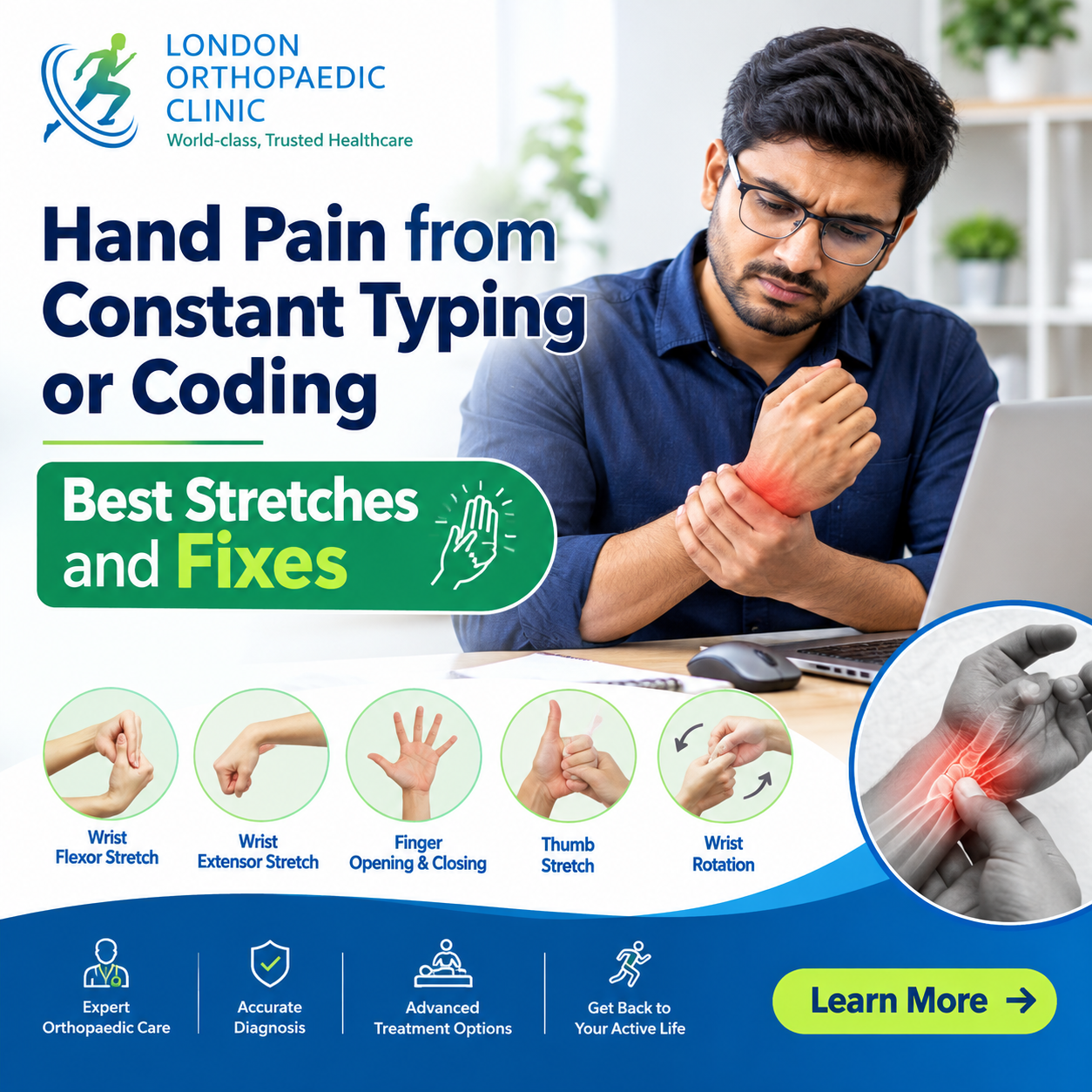
Hand Pain from Constant Typing or Coding: Best Stretches and Fixes
If you spend several hours every day typing, coding, using a mouse, designing, writing emails or working on a computer, you may gradually notice hand pain, wrist pain, finger stiffness or discomfort in the forearm. For many people, the problem starts as mild discomfort after a long working day. Over time, it may become more…