
A glass of water. A laptop bag. A grocery bag. A cricket bat. A dumbbell. Even opening a door or shaking hands.
We use our elbows for many simple movements without giving them much thought. But when elbow pain starts, ordinary activities can suddenly become difficult.
You may notice pain while lifting a cup, gripping a mobile phone, turning a key, working on a computer, exercising at the gym, playing sports, or even resting your arm. Some people experience a dull ache, while others may have sharp pain, stiffness, swelling, weakness or a feeling that the elbow is not moving normally.
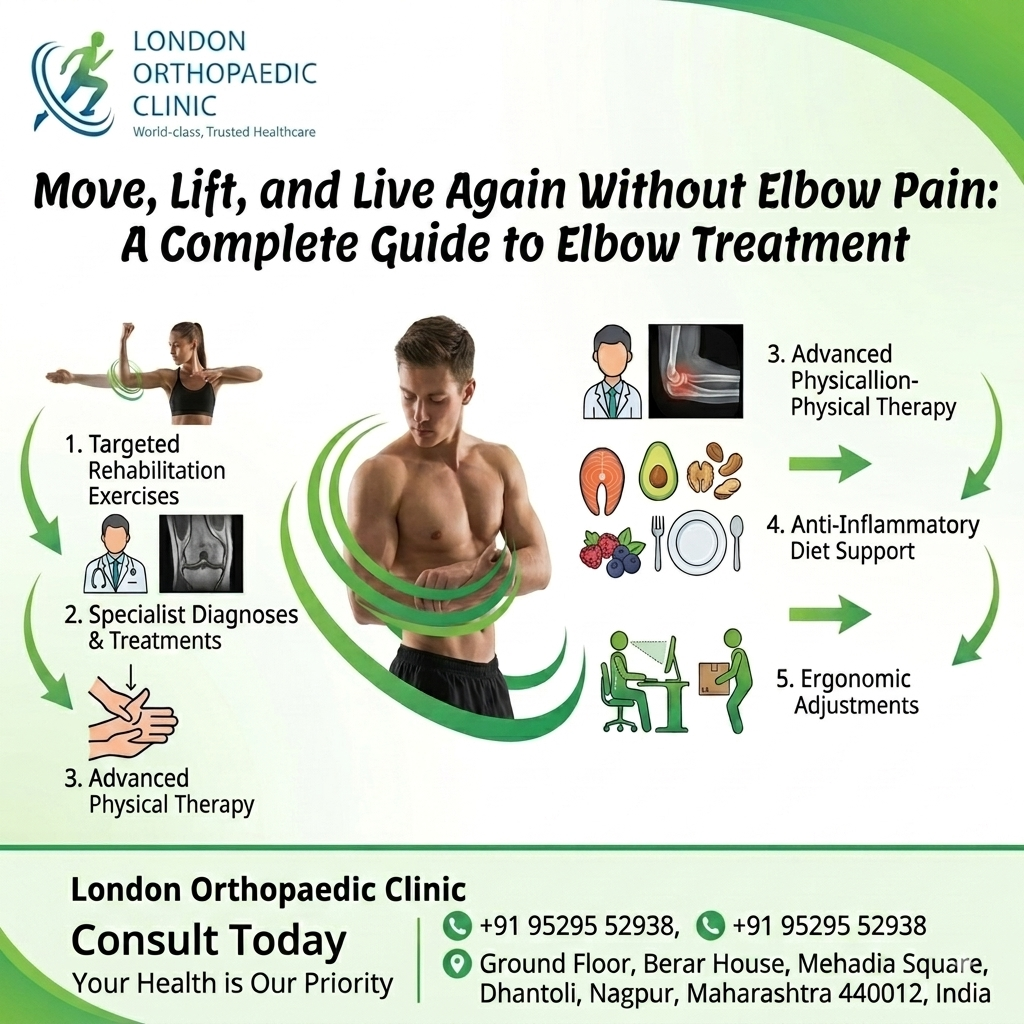
The good news is that elbow pain does not always mean surgery. The right treatment depends on the actual cause of the pain, how long you have had symptoms, the condition of your joint and tendons, and how much the problem is affecting your daily life.
Conditions such as tennis elbow and golfer’s elbow often respond to appropriate non-surgical treatment, activity modification and rehabilitation. More complex problems such as severe arthritis, cartilage damage, major injury or persistent stiffness may require advanced procedures.
At London Orthopaedic Clinic, Nagpur, Dr. Vishal Sahni provides specialised care for shoulder, elbow and wrist conditions. His qualifications include MBBS, MS ORTHO, FRCS ORTHO (London), and MCh ORTHO (Liverpool).
This guide explains the common reasons for elbow pain, available treatment options and when an expert assessment can help you move, lift and live more comfortably again.
Why Does Your Elbow Hurt?
The elbow is a complex joint where bones, cartilage, muscles, tendons, ligaments and nerves work together.
Pain can develop when any of these structures becomes irritated, injured, worn or damaged.
Common causes include:
- Tennis elbow
- Golfer’s elbow
- Sports injuries
- Repetitive strain
- Tendon problems
- Elbow arthritis
- Joint stiffness
- Cartilage damage
- Ligament injuries
- Fractures around the elbow
- Nerve irritation
- Previous elbow surgery or injury
Not every elbow problem produces pain in exactly the same place.
Pain on the outer side of the elbow is commonly associated with tennis elbow, while pain on the inner side may occur with golfer’s elbow. However, other conditions can produce similar symptoms, which is why an accurate diagnosis is important.

When Elbow Pain Starts Affecting Your Daily Life
One of the biggest mistakes people make is ignoring elbow pain because it initially appears manageable.
You may think:
“It will settle down.”
“I probably strained it at the gym.”
“Maybe I slept in the wrong position.”
“I will see a doctor if it gets worse.”
Sometimes the pain does improve with appropriate rest and activity modification. But persistent symptoms should not simply be ignored.
Elbow pain deserves attention when it begins affecting activities such as:
- Lifting objects
- Carrying shopping bags
- Writing or typing
- Using a computer mouse
- Driving
- Playing cricket or other sports
- Going to the gym
- Cooking
- Opening bottles or jars
- Shaking hands
- Dressing yourself
- Sleeping comfortably
If pain continues or your elbow becomes weak or stiff, an assessment by an elbow pain doctor in Nagpur can help identify the underlying problem.
Tennis Elbow: It Is Not Only a Tennis Player’s Problem
The name “tennis elbow” can be misleading.
You do not need to play tennis to develop it.
Tennis elbow usually causes pain around the outside of the elbow and may become worse with gripping, lifting or wrist movements. Repetitive use of the forearm can place excessive stress on the tendons around the elbow.
It can affect people involved in many everyday activities, including:
- Computer work
- Repetitive office work
- Manual work
- Gardening
- Household work
- Gym exercises
- Racquet sports
- Other activities involving repeated gripping and wrist movement
Common symptoms of tennis elbow
You may experience:
- Pain on the outer elbow
- Tenderness when touching the area
- Pain while gripping
- Difficulty lifting objects
- Weakness in the hand or forearm
- Pain during wrist movement
- Discomfort extending into the forearm
If symptoms persist, proper tennis elbow treatment in Nagpur should begin with identifying the severity and cause rather than simply treating the pain.
Treatment may include activity modification, exercises, physiotherapy, pain-management strategies and other appropriate interventions. Surgery is generally considered only in selected persistent cases when appropriate non-operative treatment has not provided adequate improvement.
Golfer’s Elbow: Pain on the Inner Side of the Elbow
Golfer’s elbow is another common tendon-related elbow condition.
It usually causes pain and tenderness around the inner side of the elbow. Despite its name, golfers are not the only people who develop it.
Repetitive gripping, lifting, throwing and other activities involving the forearm can contribute to symptoms.
A person with golfer’s elbow may experience:
- Inner elbow pain
- Tenderness
- Pain while gripping
- Weakness
- Pain during lifting
- Discomfort during sports
- Difficulty performing repetitive hand movements
Early golfer’s elbow treatment in Nagpur may focus on reducing activities that aggravate symptoms, improving movement, strengthening the affected muscles and gradually returning to normal activities. Persistent cases may require a detailed orthopaedic assessment and additional treatment.
Elbow Pain Is Not Always Tennis Elbow or Golfer’s Elbow
This is an important point.
People often search online for “tennis elbow treatment” after developing pain. But similar symptoms can occur due to different problems.
For example, elbow pain may be related to:
Elbow arthritis
Damage or degeneration within the joint can cause pain, stiffness and reduced movement.
Sports injury
A sudden injury while playing cricket, badminton, tennis, weight training or another sport may damage the bones, ligaments, tendons or cartilage around the elbow.
Elbow stiffness
After an injury, fracture, surgery or prolonged immobilisation, the elbow can become difficult to bend or straighten.
Cartilage or loose-body problems
Problems inside the joint may produce clicking, locking, catching or restricted movement.
Nerve-related symptoms
Nerve irritation can sometimes cause pain, tingling, numbness or weakness extending towards the hand.
This is why the best treatment for elbow pain depends on the diagnosis rather than the symptom alone.
How Is Elbow Pain Diagnosed?
A good treatment plan starts with understanding what is actually causing the pain.
During an orthopaedic consultation, the doctor may assess:
- Where the pain is located
- When the pain started
- Whether there was an injury
- Which movements increase the pain
- Grip strength
- Elbow range of motion
- Swelling or tenderness
- Stability of the joint
- Nerve-related symptoms
- Your work, sports and exercise activities
- Previous treatments and injuries
Depending on the symptoms and clinical findings, imaging such as an X-ray, ultrasound or MRI may sometimes be recommended.
Importantly, not every elbow pain problem requires an MRI or surgery. The appropriate investigation depends on the suspected condition.
Treatment for Elbow Pain: Start With the Right Approach
Treatment should be personalised.
Two people can have elbow pain but need completely different treatment.
For some patients, the goal may be to reduce tendon overload and restore strength. For others, treatment may focus on joint stiffness, arthritis, cartilage damage or an old injury.
1. Activity modification
If a particular activity repeatedly increases your pain, temporarily reducing or modifying that activity may help.
This does not always mean complete rest.
In many tendon-related elbow conditions, gradually returning to activity while controlling the load can be more useful than avoiding all movement for a long period.
2. Physiotherapy and rehabilitation
A structured rehabilitation programme can help improve:
- Elbow movement
- Forearm strength
- Grip strength
- Flexibility
- Muscle control
- Functional movement
Exercise selection should depend on the diagnosis and stage of recovery.
Simply copying random exercises from the internet may not be appropriate for every elbow condition.
3. Medicines and pain management
Depending on your medical history and diagnosis, a doctor may recommend appropriate medicines or topical treatments for symptom control.
Do not routinely take pain medicines without considering possible side effects, other medicines you may be using and existing health conditions. A doctor or pharmacist can guide you about safe use.
4. Bracing or support
In selected tendon conditions, an elbow or forearm support may help reduce strain during certain activities.
However, a brace should be considered part of an overall treatment plan rather than a permanent solution.
5. Advanced treatment when required
Some persistent or structurally significant elbow conditions may need additional procedures.
The decision should be based on the diagnosis, severity of symptoms, functional limitation and response to previous treatment.
When Is Elbow Arthroscopy Considered?
Elbow arthroscopy is a minimally invasive surgical technique in which a small camera and specialised instruments are introduced into the joint through small incisions.
It may be used in selected patients for conditions involving the inside of the elbow joint, such as certain loose bodies, cartilage problems, stiffness and other problems that are suitable for arthroscopic treatment.
The advantage of a minimally invasive approach, when appropriate, is that the surgeon can directly visualise the joint and perform the required procedure through small access points.
However, elbow arthroscopy is not automatically the correct treatment for every patient with elbow pain.
A specialist assessment is necessary to determine whether arthroscopy is appropriate.
Patients specifically searching for elbow arthroscopy in Nagpur should therefore focus not only on the procedure but also on the surgeon’s experience with elbow conditions and the accuracy of the diagnosis.
When Is Elbow Replacement Needed?
Elbow replacement is very different from treatment for tennis elbow or golfer’s elbow.
Elbow joint replacement may be considered in selected patients with severe damage to the elbow joint where pain and loss of function are significantly affecting quality of life and other treatment options are no longer sufficient.
Possible reasons may include:
- Advanced arthritis
- Severe joint destruction
- Certain complex fractures
- Significant damage following previous injury
- Persistent pain and functional limitation associated with severe joint disease
Elbow replacement involves replacing damaged joint surfaces with artificial components designed to restore useful movement and reduce pain.
It is a major decision and requires careful assessment of the patient’s age, activity level, bone and joint condition, overall health and expectations.
If replacement is being considered, choosing an experienced elbow joint replacement surgeon is important because appropriate patient selection, surgical planning and rehabilitation all contribute to the treatment journey.
Elbow Replacement Is Not the First Answer to Every Elbow Problem
This distinction is important for patients.
A person with tennis elbow does not automatically need elbow replacement.
Similarly, an active person with a mild tendon problem should not assume that surgery is the only route to recovery.
Modern orthopaedic care aims to match the treatment to the condition.
For one patient, physiotherapy may be the main treatment.
For another, an arthroscopic procedure may be appropriate.
For someone with severe joint destruction, elbow joint replacement may become an option.
The objective is not simply to perform a procedure. The objective is to restore useful function and help the patient return to daily life as safely as possible.
Why Early Expert Assessment Can Make a Difference
Persistent pain changes how people use their arms.
You may unconsciously stop using the painful arm, change your lifting technique or avoid certain activities.
Over time, this can contribute to weakness, stiffness and reduced confidence in movement.
An early orthopaedic assessment can help answer important questions:
- What is causing my elbow pain?
- Is it a tendon, joint, ligament or nerve problem?
- Do I need an X-ray or other imaging?
- Can my problem improve without surgery?
- What activities should I modify?
- Would physiotherapy help?
- Is surgery actually required?
- When can I return to work, gym or sport?
Getting these answers can be more useful than repeatedly taking painkillers without knowing the underlying cause.
When Should You See an Elbow Specialist?
You should consider an orthopaedic consultation if:
- Elbow pain persists despite reasonable rest and activity modification
- Pain is getting worse
- You cannot lift normal objects comfortably
- Your grip has become weak
- Your elbow is becoming stiff
- You experience repeated swelling
- The elbow locks or catches
- You have persistent pain after an injury
- You experience numbness or tingling
- Sports performance is affected
- Pain is disturbing sleep
- Previous treatment has not worked
Seek prompt medical assessment after a significant injury, especially if there is severe pain, major swelling, deformity or inability to use the arm normally. Fever associated with a hot, red and swollen joint also requires urgent medical attention.
Your Goal Should Be More Than Just “Less Pain”
Pain relief is important, but successful elbow treatment should ideally go further.
The bigger goal is to help you regain useful function.
That may mean being able to:
- Lift your child
- Carry your shopping bag
- Work comfortably
- Use a computer without constant discomfort
- Return to the gym
- Play cricket
- Resume your favourite sport
- Drive comfortably
- Cook and perform household activities
- Sleep without elbow pain
- Use your arm confidently again
This is why diagnosis, treatment and rehabilitation need to work together.
Why Choose Dr. Vishal Sahni for Elbow Care in Nagpur?
Dr. Vishal Sahni is an orthopaedic surgeon specialising in shoulder, elbow and wrist treatments.
His qualifications include:
MBBS
MS ORTHO
FRCS ORTHO (London)
MCh ORTHO (Liverpool)
His focused upper-limb orthopaedic practice includes conditions such as tennis elbow, golfer’s elbow, elbow injuries, elbow stiffness and other shoulder, elbow and wrist disorders. London Orthopaedic Clinic also provides advanced evaluation and treatment options for conditions that may require procedures such as elbow arthroscopy or elbow joint replacement.
A specialist approach is particularly valuable when elbow symptoms are persistent, recurrent, difficult to diagnose or affecting work, sports and daily activities.
The treatment philosophy should always be simple:
Diagnose correctly. Treat appropriately. Operate only when necessary. Rehabilitate properly.
Expert Elbow Treatment for Patients Across Central India
London Orthopaedic Clinic in Nagpur is accessible to patients from different parts of Central India who are looking for specialised shoulder, elbow and wrist care.
Patients may travel from Jabalpur, Bhopal, Raipur, Seoni, Chhindwara, Wardha, Amravati, Chandrapur and Yavatmal, as well as other parts of Maharashtra, Madhya Pradesh and Chhattisgarh, for specialist orthopaedic consultation.
Online consultation is also available for patients who cannot immediately travel to Nagpur and want an initial expert opinion about their elbow problem.
Take the First Step Towards Moving Your Arm Again
Living with elbow pain can slowly make your world smaller.
You stop lifting.
You avoid sports.
You change how you work.
You hesitate before picking up a bag.
You may even start avoiding simple movements that were once automatic.
But persistent elbow pain deserves a proper diagnosis—not guesswork.
Whether your symptoms are related to tennis elbow, golfer’s elbow, sports injury, arthritis, stiffness, cartilage damage or another elbow condition, the right treatment depends on understanding what is happening inside and around the joint.
If you are searching for elbow pain treatment in Nagpur, tennis elbow treatment Nagpur, golfer’s elbow treatment Nagpur, elbow arthroscopy Nagpur, or an experienced elbow joint replacement surgeon, consider getting a specialist assessment before the problem starts controlling your daily life.
The goal is simple:
Move better. Lift with confidence. Return to the activities you enjoy. Live your life without letting elbow pain decide what you can and cannot do.
Consult Dr. Vishal Sahni at London Orthopaedic Clinic Nagpur
Dr. Vishal Sahni
MBBS, MS ORTHO, FRCS ORTHO (London), MCh ORTHO (Liverpool)
Shoulder, Elbow & Wrist Specialist
London Orthopaedic Clinic
Ground Floor, Berar House,
Mehadia Square, Dhantoli,
Nagpur, Maharashtra 440012, India
Mobile / WhatsApp: +91 95295 52938
Online Consultation Available
Website: londonorthopaedicclinicngp.com
If elbow pain is stopping you from moving, lifting, working, exercising or enjoying daily life, consult an orthopaedic specialist for an accurate diagnosis and personalised treatment plan.
Frequently Asked Questions About Elbow Pain
1. What are the common causes of elbow pain?
Common causes of elbow pain include tennis elbow, golfer’s elbow, sports injuries, repetitive strain, arthritis, tendon problems, ligament injuries, elbow stiffness and certain nerve-related conditions. The exact cause can only be confirmed through a proper clinical assessment.
2. When should I see an elbow pain doctor in Nagpur?
You should consult an elbow specialist if your pain continues, becomes worse, affects your grip or movement, causes stiffness or swelling, disturbs sleep, or prevents you from working, exercising or performing daily activities. Persistent elbow pain should not be ignored.
3. What is the best treatment for elbow pain?
There is no single treatment that is best for everyone. Treatment depends on the cause and severity of the problem. It may include activity modification, physiotherapy, exercises, medicines, supportive treatment or surgery in selected cases.
4. What is tennis elbow?
Tennis elbow is a condition that usually causes pain and tenderness on the outer side of the elbow. It can develop because of repeated gripping and wrist or forearm movements. Despite its name, it can affect people who do not play tennis.
5. What is the treatment for tennis elbow?
Tennis elbow treatment may include activity modification, appropriate exercises, physiotherapy and pain-management measures. Most patients do not immediately require surgery. Persistent or difficult cases should be assessed by an orthopaedic specialist.
6. Where can I get tennis elbow treatment in Nagpur?
Patients looking for tennis elbow treatment in Nagpur can consult Dr. Vishal Sahni at London Orthopaedic Clinic, Dhantoli, Nagpur. He specialises in shoulder, elbow and wrist conditions and can assess the cause and severity of elbow pain before recommending treatment.
7. What is golfer’s elbow?
Golfer’s elbow is a tendon-related condition that commonly causes pain and tenderness on the inner side of the elbow. Repetitive gripping, lifting, throwing and forearm activities can contribute to the condition. You do not have to play golf to develop golfer’s elbow.
8. What is the treatment for golfer’s elbow?
Golfer’s elbow treatment in Nagpur may involve modifying activities that aggravate pain, physiotherapy, strengthening exercises and other appropriate non-surgical treatments. If symptoms persist despite treatment, an orthopaedic assessment can help determine the next step.
9. What is elbow arthroscopy?
Elbow arthroscopy is a minimally invasive surgical procedure in which a small camera and specialised instruments are inserted into the elbow joint through small incisions. It may be useful for selected problems affecting the joint, including certain cases of stiffness, loose bodies and cartilage-related conditions.
10. When is elbow arthroscopy required?
Elbow arthroscopy may be considered when a suitable problem inside the elbow joint cannot be adequately managed with non-surgical treatment. The decision depends on the diagnosis, symptoms, imaging findings and overall condition of the elbow.
11. Is elbow surgery always necessary for elbow pain?
No. Many elbow conditions can initially be managed without surgery. Surgery is considered when there is a specific problem that requires an operation or when appropriate non-surgical treatment has not provided sufficient improvement.
12. What is elbow joint replacement?
Elbow joint replacement is a surgical procedure in which damaged parts of the elbow joint are replaced with artificial components. It may be considered for selected patients with severe joint damage, advanced arthritis or certain complex injuries.
13. When is elbow joint replacement recommended?
Elbow joint replacement may be considered when severe elbow joint damage causes significant pain and loss of function and other appropriate treatments are no longer providing adequate relief. Patient selection is important, so a specialist assessment is necessary.
14. How do I choose an elbow joint replacement surgeon?
When considering an elbow joint replacement surgeon, look for appropriate orthopaedic qualifications, experience with elbow conditions, careful diagnosis, clear explanation of treatment options and a structured rehabilitation plan. The surgeon should also explain the expected benefits, limitations and risks of the procedure.
15. Can elbow pain be treated without surgery?
Yes. Depending on the diagnosis, many elbow conditions can improve with activity modification, physiotherapy, exercises and other non-surgical treatments. However, treatment should be based on the actual cause rather than simply treating the pain.
16. Can physiotherapy help elbow pain?
Physiotherapy can be useful for many elbow conditions. A customised programme may help improve flexibility, strength, grip function, joint movement and the ability to return gradually to normal activities.
17. Can elbow pain come back after treatment?
Some elbow conditions can recur, particularly when the activities that caused excessive stress on the elbow are resumed too quickly. Following rehabilitation instructions, gradually increasing activity and addressing contributing factors can help reduce the chance of recurrence.
18. Can I play sports with elbow pain?
Continuing sports despite significant elbow pain may worsen symptoms in some conditions. The appropriate time to return to sport depends on the diagnosis, pain level, strength, movement and recovery. An orthopaedic specialist or physiotherapist can guide a safe return to activity.
19. Why is my elbow painful when I lift something?
Pain while lifting may occur because of tendon irritation, tennis elbow, golfer’s elbow, arthritis, injury or other elbow problems. If lifting repeatedly causes pain or weakness, an accurate diagnosis is important before continuing activities that aggravate the symptoms.
20. Where can I consult an elbow specialist in Nagpur?
You can consult Dr. Vishal Sahni, a shoulder, elbow and wrist specialist, at London Orthopaedic Clinic, Dhantoli, Nagpur.
Address: Ground Floor, Berar House, Mehadia Square, Dhantoli, Nagpur, Maharashtra 440012, India.
Mobile / WhatsApp: +91 95295 52938
Online consultation: Available.
-
Where to Go for Dislocated Shoulder Treatment in Nagpur? A Patient’s Guide
A dislocated shoulder can be extremely painful and frightening. It usually happens when the upper arm bone comes out of the shoulder socket following a fall, accident, sports injury or sudden force. If the shoulder looks deformed, the arm cannot be moved normally, or there is severe pain after an injury, medical assessment should not…
-
Orthopaedic Specialist in Nagpur for Arm Weakness and Pain: Causes, Diagnosis & Treatment
Arm pain with weakness can make simple activities such as lifting a bag, combing your hair, dressing, reaching overhead or playing sports difficult. While many people assume the problem is only muscle pain, the actual cause may involve the shoulder joint, rotator cuff, elbow, wrist, nerves or an injury. If you are searching for an…
-
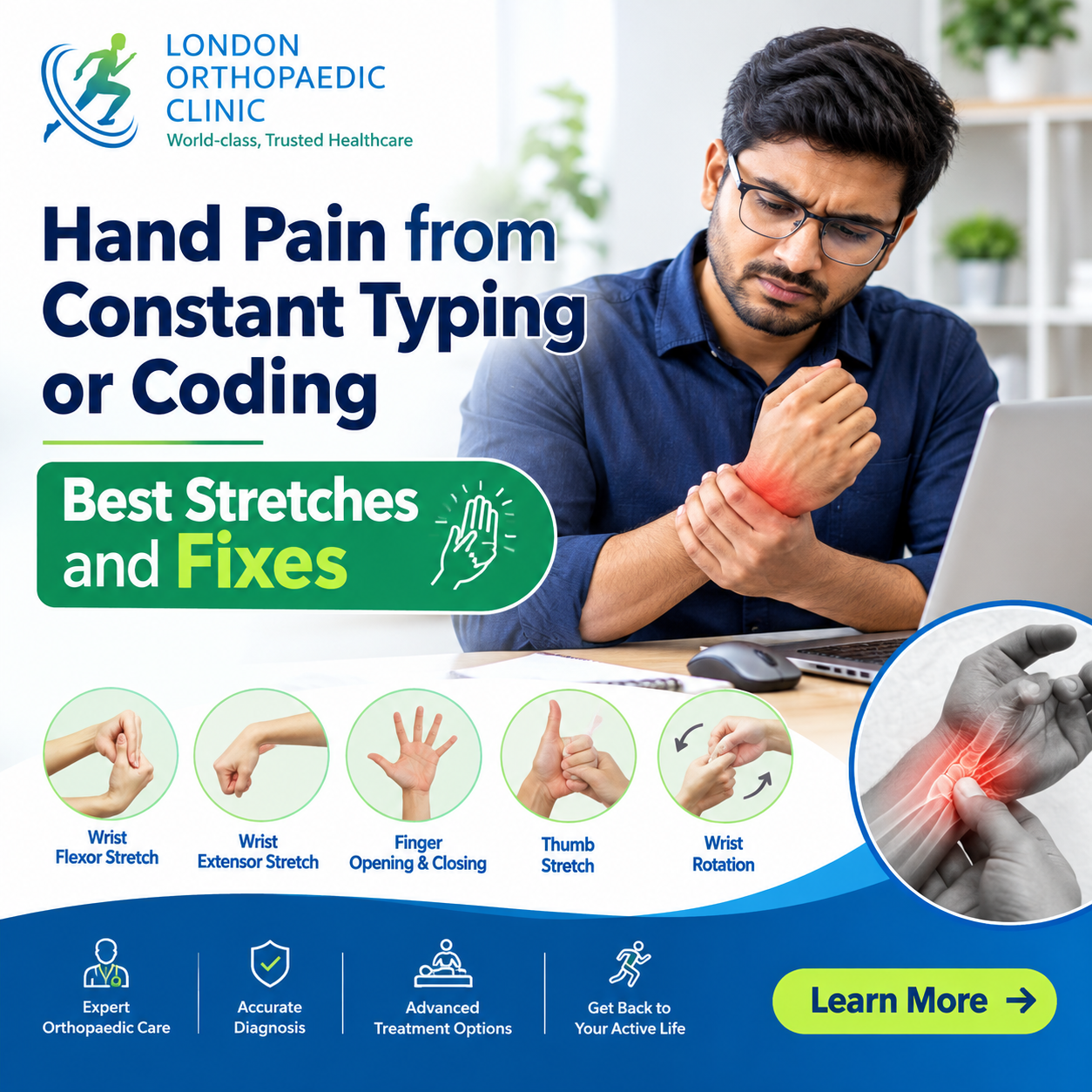
Hand Pain from Constant Typing or Coding: Best Stretches and Fixes
If you spend several hours every day typing, coding, using a mouse, designing, writing emails or working on a computer, you may gradually notice hand pain, wrist pain, finger stiffness or discomfort in the forearm. For many people, the problem starts as mild discomfort after a long working day. Over time, it may become more…