
By Dr. Vishal Sahni – Shoulder, Elbow & Wrist Specialist, London Orthopaedic Clinic, Nagpur
Have you ever wondered why two people can both say, “My shoulder is hurting,” but require completely different treatments?
One person may have pain while lifting the arm overhead. Another may struggle to move the shoulder at all because of severe stiffness. Someone else may have deep shoulder pain because the joint has developed arthritis.
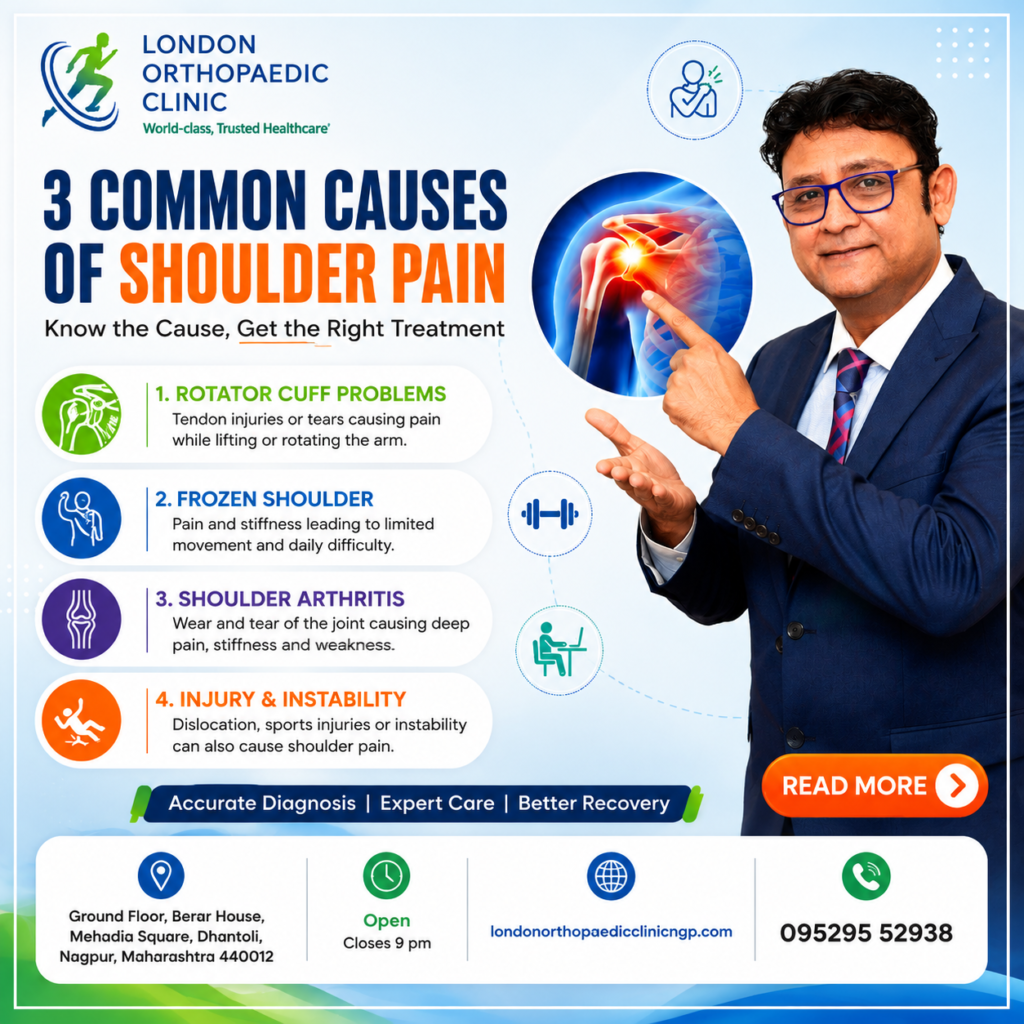
The word “shoulder pain” describes a symptom. It does not tell us the actual condition causing that pain.
This is one of the most important things patients should understand before choosing a treatment.
Shoulder pain can develop because of an injury to the tendons, a problem inside the joint, stiffness of the joint capsule, arthritis, instability, or even pain coming from the neck. Medical guidance also confirms that different shoulder symptoms can point towards different underlying causes.
So, if you are searching online for shoulder pain treatment Nagpur, the first question should not simply be, “Which treatment is best?”
The more important question is:
“What is actually causing my shoulder pain?”
At London Orthopaedic Clinic in Nagpur, Dr. Vishal Sahni focuses on diagnosing the underlying problem before recommending treatment. His area of expertise includes the shoulder, elbow and wrist, with treatment ranging from non-surgical care to advanced arthroscopic procedures and shoulder replacement surgery when appropriate.
Why All Shoulder Pain Should Not Be Treated in the Same Way
The shoulder is one of the most mobile joints in the human body. It allows us to reach overhead, dress ourselves, comb our hair, lift objects, play sports and perform many everyday movements.
Because it has such a wide range of movement, several different structures can become painful.
The muscles and tendons around the shoulder can become irritated or torn. The joint capsule can become tight and painful. Cartilage can wear away with arthritis. A previous injury can make the shoulder unstable.
This means that two patients with similar-looking pain may have very different diagnoses.
For example:
- Pain mainly during overhead movement may be related to a tendon problem.
- Pain combined with progressively increasing stiffness may suggest frozen shoulder.
- Deep pain, stiffness and loss of movement in an older patient may be related to arthritis.
- Sudden pain after a fall may indicate an injury or dislocation.
- Pain travelling from the neck towards the shoulder may not actually originate in the shoulder joint.
This is why a proper clinical examination is important. Shoulder pain should not be diagnosed only by looking at the location of the pain.

The 3 Major Causes of Shoulder Pain
There are many possible reasons for shoulder pain. However, three important categories that patients commonly encounter are:
- Rotator cuff problems and tendon injuries
- Frozen shoulder
- Shoulder arthritis and joint degeneration
These conditions can overlap. A patient may even have more than one shoulder problem at the same time.
Let us understand how they differ.
1. Rotator Cuff Problems and Tears
One of the most common reasons for shoulder pain is a problem involving the rotator cuff.
The rotator cuff is a group of four muscles and their tendons that help move and stabilise the shoulder. These tendons play an important role when you raise, rotate or control your arm.
A rotator cuff problem may range from irritation or degeneration of a tendon to a partial or complete tear.
What can cause a rotator cuff problem?
A rotator cuff injury can happen suddenly or develop gradually.
For example, a person may injure the shoulder while:
- Falling onto the arm
- Lifting a heavy object
- Playing cricket or another sport
- Performing repetitive overhead activities
- Exercising with weights
- Making an awkward movement
Age-related changes can also weaken the tendons over time.
Some people therefore develop shoulder pain without remembering one particular injury.
This is important because patients sometimes say:
“Doctor, I never fell down, so how can I have a rotator cuff tear?”
A tear does not always happen because of one major accident. Tendons can gradually become weaker and eventually become painful or tear with everyday activity.
What does rotator cuff pain feel like?
The symptoms can vary depending on the tendon involved and the severity of the problem.
Common symptoms may include:
- Pain when raising the arm
- Pain while reaching overhead
- Difficulty reaching behind the back
- Weakness in the arm
- Pain while sleeping on the affected side
- Pain during sports or gym activities
- Difficulty lifting objects
- Pain that becomes worse with repeated shoulder movements
Some patients describe the pain as being around the outer or upper part of the shoulder and upper arm.
However, symptoms alone cannot confirm a rotator cuff tear.
A detailed examination may be required, and depending on the situation, imaging such as ultrasound, X-ray or MRI may help the doctor understand the condition.
Does every rotator cuff tear require surgery?
No.
This is an important point for patients.
A rotator cuff tear does not automatically mean that surgery is required.
Treatment depends on several factors, including:
- The patient’s age
- The size and type of tear
- Whether the tear happened suddenly or developed gradually
- Shoulder strength
- Functional limitations
- Duration of symptoms
- Activity and sports requirements
- Response to non-surgical treatment
Depending on the diagnosis, treatment may include activity modification, medication, rehabilitation and physiotherapy.
In selected patients with significant tears or persistent symptoms, surgery may be considered.
When surgery is appropriate, arthroscopic shoulder surgery Nagpur may be an option. Arthroscopy uses small incisions and a camera to allow the surgeon to examine and treat problems inside the shoulder.
Dr. Vishal Sahni has expertise in arthroscopic shoulder procedures and rotator cuff treatment. His approach is to recommend surgery when the patient’s condition genuinely requires it rather than assuming that every shoulder problem needs an operation.
Internal linking opportunity: Link the phrase “rotator cuff tear treatment Nagpur” to your dedicated rotator cuff treatment page.
2. Frozen Shoulder: When Pain Comes With Stiffness
Now consider a completely different situation.
A patient says:
“My shoulder is painful, but the bigger problem is that I cannot move my arm properly.”
This may be a sign of frozen shoulder, medically known as adhesive capsulitis.
Frozen shoulder is different from a simple muscle strain.
The shoulder becomes painful and progressively stiff. Everyday activities such as wearing clothes, reaching behind the back, combing hair or lifting the arm can become difficult.
Medical guidance lists frozen shoulder among the important causes of persistent shoulder pain and stiffness.
What makes frozen shoulder different?
The key feature is loss of movement.
A patient with a rotator cuff problem may have pain and weakness, but a patient with frozen shoulder often has significant restriction of shoulder movement.
For example, the person may find it difficult to:
- Raise the arm
- Reach behind the head
- Put the hand behind the back
- Wear or remove clothes
- Reach for objects on a high shelf
- Sleep comfortably because of shoulder pain
The stiffness can gradually become more noticeable.
Some patients initially believe that the shoulder is simply “getting weak” or that the pain is due to age.
But frozen shoulder has a different pattern.
Why should frozen shoulder be diagnosed properly?
Not every stiff shoulder is frozen shoulder.
Shoulder arthritis, a rotator cuff problem, previous injury and other joint conditions can also cause stiffness.
That is why simply searching for “frozen shoulder treatment Nagpur” and starting treatment without a proper diagnosis may not be appropriate.
A shoulder specialist can assess:
- How much the shoulder can move
- Whether active and passive movement are restricted
- Where the pain occurs
- Whether weakness is present
- Whether there has been previous trauma
- Whether another condition may be responsible
Treatment is then selected according to the individual’s condition.
What is the treatment for frozen shoulder?
The treatment of frozen shoulder depends on the stage and severity of the condition.
Many patients can improve with non-surgical treatment. This may include appropriate pain management, physiotherapy and measures designed to restore shoulder movement.
In selected cases, a specialist may recommend other interventions when pain and stiffness remain significant.
At London Orthopaedic Clinic, Dr. Vishal Sahni assesses the patient’s shoulder carefully before deciding on the appropriate treatment pathway. His clinical expertise includes the management of frozen shoulder and other complex shoulder conditions.
Internal linking opportunity: Link “frozen shoulder treatment Nagpur” to the dedicated frozen shoulder treatment page.
3. Shoulder Arthritis: When the Joint Itself Becomes the Problem
The third major cause is shoulder arthritis.
Unlike a tendon problem, where the rotator cuff may be involved, arthritis affects the joint surfaces and cartilage.
The shoulder is a ball-and-socket joint. Healthy cartilage allows the joint surfaces to move smoothly.
When cartilage becomes damaged or significantly worn, movement can become painful and restricted.
Shoulder arthritis may cause:
- Deep shoulder pain
- Stiffness
- Reduced movement
- Pain during daily activities
- Difficulty reaching overhead
- Difficulty dressing
- Pain at night
- Reduced ability to use the affected arm
Age-related joint changes are one recognised cause of shoulder pain.
How is arthritis-related shoulder pain different?
Patients with arthritis often describe pain as being deeper inside the shoulder.
The shoulder may gradually become less mobile.
Simple activities that were once effortless can become uncomfortable.
For example, a person may struggle with:
Combing hair → wearing a shirt → reaching for a cupboard → lifting a bag → sleeping on the affected side
The problem may gradually become more limiting.
In advanced cases, pain can become persistent and significantly affect quality of life.
When is shoulder replacement surgery considered?
Not every patient with shoulder arthritis needs a shoulder replacement.
Treatment depends on the severity of the arthritis, symptoms, functional limitations, age, overall health and response to other treatments.
When severe joint damage causes persistent pain and significantly affects daily life, shoulder replacement surgery Nagpur may be considered.
There are different types of shoulder replacement procedures.
Depending on the condition of the joint and rotator cuff, a patient may be considered for an anatomic total shoulder replacement or a reverse shoulder replacement surgery Nagpur.
Reverse shoulder replacement is particularly useful in selected patients with severe joint damage associated with major rotator cuff deficiency.
Dr. Vishal Sahni performs total and reverse shoulder replacement procedures and evaluates each patient individually before recommending surgery.
Internal linking opportunity: Link “shoulder replacement surgery Nagpur” to the clinic’s shoulder replacement page and “reverse shoulder replacement surgery Nagpur” to the dedicated reverse shoulder replacement page.
Three Patients, Three Different Shoulder Problems
Imagine three patients visiting an orthopaedic clinic.
Patient 1: “My shoulder hurts when I lift my arm.”
The problem may involve the rotator cuff or another tendon structure.
Patient 2: “My shoulder hurts and I cannot move it properly.”
Frozen shoulder may be one possibility, but other causes of stiffness must also be considered.
Patient 3: “My shoulder has been painful for months and is becoming increasingly stiff.”
Arthritis or another chronic joint condition may need to be investigated.
The important lesson is simple:
The location of the pain alone does not tell you the diagnosis.
A shoulder specialist looks at the complete picture.
Why Correct Diagnosis Matters Before Treatment
One of the biggest mistakes patients make is choosing treatment before knowing the cause.
For example, treatment that is appropriate for frozen shoulder may not be the same as treatment for a significant rotator cuff tear.
Similarly, arthritis-related pain may require a completely different treatment strategy.
A proper assessment usually considers:
- Medical history
- Previous injuries
- Duration of symptoms
- Pain pattern
- Shoulder movement
- Muscle strength
- Joint stability
- Neck examination when required
- Imaging when clinically indicated
Medical sources also emphasise that shoulder pain has multiple possible causes and that assessment helps determine the appropriate treatment.
This is why searching for an orthopedic surgeon near me is only the beginning. The more important step is finding a specialist who understands the specific condition affecting your shoulder.
When Should You See a Shoulder Specialist?
You should consider an orthopaedic assessment if your shoulder pain:
- Continues or keeps returning
- Is affecting your sleep
- Makes daily activities difficult
- Causes significant stiffness
- Causes weakness
- Started after an injury
- Makes it difficult to raise your arm
- Is getting progressively worse
- Is associated with instability or repeated dislocation
Sudden severe pain, inability to move the arm, a visibly changed shoulder shape after injury, significant swelling or neurological symptoms require prompt medical assessment.
Shoulder Pain Treatment in Nagpur: Why Specialist Evaluation Matters
If you are searching online for a shoulder pain doctor Nagpur, shoulder joint specialist Nagpur, or shoulder specialist in Nagpur, remember that the goal should not simply be to find someone who treats pain.
The goal is to identify the actual source of the pain and understand which treatment is appropriate for you.
At London Orthopaedic Clinic, Nagpur, Dr. Vishal Sahni specialises in shoulder, elbow and wrist conditions.
His qualifications include:
MBBS, MS ORTHO, FRCS ORTHO (London), MCh ORTHO (Liverpool)
He has more than 24 years of experience in orthopaedic practice across India and the UK and focuses on conditions involving the shoulder and upper limb.
Treatment may range from conservative management and rehabilitation to advanced procedures such as:
- Arthroscopic shoulder surgery
- Rotator cuff repair
- Shoulder dislocation treatment
- Total shoulder replacement
- Reverse shoulder replacement
- Treatment of shoulder arthritis
- Frozen shoulder management
The treatment decision is based on the individual patient’s diagnosis rather than simply the severity of pain.
Shoulder Care for Patients Across Central India
London Orthopaedic Clinic Nagpur also receives patients from different parts of Central India who are looking for specialised upper-limb care.
Patients may travel from:
Nagpur, Jabalpur, Bhopal, Raipur, Sivani, Chhindwara, Wardha, Amaravati, Chandrapur and Yavatmal.
Patients from Maharashtra, Madhya Pradesh and Chhattisgarh can also enquire about online consultation when travelling to Nagpur is difficult.
For patients who live outside Nagpur, an online consultation can be a useful first step to discuss symptoms, previous reports and the possible next stage of evaluation.
Your Shoulder Pain Deserves the Right Diagnosis
Shoulder pain should not always be treated as a simple muscle problem.
A painful shoulder may be caused by a rotator cuff problem, frozen shoulder, arthritis or another condition affecting the shoulder or surrounding structures.
That is why the most important first step is not choosing surgery.
It is understanding why the shoulder hurts.
If you have persistent shoulder pain, stiffness, weakness or difficulty using your arm, an assessment by a dedicated shoulder specialist can help identify the underlying problem and guide you towards the appropriate treatment.
At London Orthopaedic Clinic, Nagpur, Dr. Vishal Sahni provides specialised care for shoulder, elbow and wrist conditions with a focus on accurate diagnosis, personalised treatment and appropriate use of advanced surgical techniques when required.
Do not ignore persistent shoulder pain simply because you have become used to it. The right diagnosis can be the first step towards better movement and a better quality of life.
Consult Dr. Vishal Sahni – Shoulder, Elbow & Wrist Specialist
London Orthopaedic Clinic
Address: Ground Floor, Berar House, Mehadia Square, Dhantoli, Nagpur, Maharashtra 440012, India
Mobile / WhatsApp: +91 9529552938
Online Consultation: Available
Website: londonorthopaedicclinicngp.com
Map / Directions:Mehadia Square, Dhantoli, Nagpur
If your shoulder pain is persistent, worsening, affecting sleep or limiting your normal activities, consider consulting a shoulder specialist for a proper diagnosis rather than treating the pain based only on symptoms.
How Is the Cause of Shoulder Pain Diagnosed?
Knowing that you have shoulder pain is only the starting point. The next and more important step is finding out why your shoulder is painful.
A good shoulder assessment does not depend on one symptom alone.
A specialist usually considers your complete history, examines the shoulder and checks how the joint, muscles and tendons are functioning. Depending on the suspected problem, imaging may also be recommended. NHS guidance similarly notes that healthcare professionals examine the shoulder to identify the cause and may use tests such as an X-ray when needed.
Your Pain Pattern Can Give Important Clues
During consultation, a shoulder specialist may ask questions such as:
- When did the pain begin?
- Did it start suddenly or gradually?
- Was there a fall, accident or sports injury?
- Is the pain worse when lifting the arm?
- Can you reach behind your back?
- Is the shoulder becoming progressively stiff?
- Does the pain disturb your sleep?
- Do you feel weakness in the arm?
- Have you experienced a shoulder dislocation before?
- Does the pain come from the neck or travel down the arm?
- Have you already tried medicines or physiotherapy?
These questions may appear simple, but they can help differentiate between different shoulder conditions.
For example, pain with overhead movement and weakness can occur with rotator cuff disorders, while significant pain combined with progressive restriction of movement is more suggestive of frozen shoulder. Arthritis can also produce pain and stiffness.
Physical Examination Is an Important Part of Diagnosis
A scan alone cannot always tell the complete story.
A shoulder specialist may assess:
Range of movement
The doctor checks how far you can move your shoulder in different directions.
This is particularly important when distinguishing a painful shoulder from a genuinely stiff shoulder.
Muscle strength
Strength testing can help identify possible rotator cuff dysfunction or other problems affecting the shoulder.
Shoulder stability
If you have experienced repeated dislocations or a feeling that the shoulder may “come out,” stability testing becomes important.
Joint tenderness
The location of tenderness can provide additional information about which structure may be involved.
Neck and nerve assessment
Sometimes pain felt around the shoulder actually comes from the neck or nerves.
This is another reason why self-diagnosis can be misleading.
Which Tests May Be Used for Shoulder Pain?
Not every patient needs every test.
The choice depends on the clinical findings.
X-ray
An X-ray can help assess the bones and joint and may show changes associated with arthritis, fractures or other structural problems.
In suspected frozen shoulder, an X-ray can also help exclude other conditions such as osteoarthritis.
Ultrasound
Ultrasound can be useful for assessing soft tissues around the shoulder, including some rotator cuff problems.
It may be particularly useful when the doctor suspects a tendon-related problem.
MRI
An MRI provides detailed information about soft tissues and can be useful when evaluating rotator cuff tears, labral problems and other structures that may not be clearly visible on an X-ray.
The decision to order an MRI should be based on the clinical situation rather than simply requesting a scan for every shoulder pain complaint.
Why You Should Not Choose Treatment Based Only on an MRI Report
Many patients search online after receiving an MRI report and become worried after seeing words such as:
“tear,” “degeneration,” “tendinopathy” or “arthritis.”
But an imaging report is only one part of the diagnosis.
A structural change on a scan does not automatically mean that surgery is required.
The doctor needs to understand whether the scan finding matches:
- Your symptoms
- Your clinical examination
- Your age
- Your activity level
- Your functional limitations
- The duration of your problem
This is one reason why seeing a shoulder joint specialist Nagpur can be helpful when symptoms are persistent or difficult to understand.
The aim should be to treat the patient, not simply the scan.
Treatment Depends on the Cause
There is no single treatment called “shoulder pain treatment.”
The appropriate treatment depends on the diagnosis.
This is perhaps the most important message of this article.
A patient with a rotator cuff problem may need a different approach from someone with frozen shoulder. A patient with advanced arthritis may require a completely different treatment plan.
Treatment can range from non-surgical care to minimally invasive procedures or joint replacement in selected patients.
Non-Surgical Treatment May Be Appropriate for Many Patients
Not every painful shoulder needs surgery.
Depending on the diagnosis, non-surgical management may include:
- Activity modification
- Appropriate medication
- Physiotherapy
- Rehabilitation
- Improvement of shoulder movement
- Strengthening under professional guidance
- Treatment of associated conditions
- In selected cases, injections
The exact treatment should be individualised.
For example, frozen shoulder is commonly managed initially with pain control and measures aimed at restoring movement. Physiotherapy can play an important role in recovering shoulder movement.
Similarly, some tendon-related shoulder problems can initially be managed without surgery.
This is why a good shoulder surgeon in Nagpur should not simply look at surgery as the first solution.
The correct treatment is the treatment that matches the patient’s diagnosis and needs.
When Can Shoulder Surgery Become Necessary?
Surgery may be considered when:
- There is a significant structural injury
- Symptoms continue despite appropriate non-surgical treatment
- Shoulder function remains substantially limited
- There is severe joint damage
- A significant rotator cuff tear requires repair
- The shoulder repeatedly dislocates
- Arthritis has become advanced
- Pain is significantly affecting quality of life
However, surgery is not decided simply because a patient has pain.
A specialist evaluates the severity of the condition, expected benefits, risks and available alternatives.
At London Orthopaedic Clinic, the clinic’s stated focus includes shoulder and upper-limb conditions, sports injuries, arthritis, joint replacement and minimally invasive orthopaedic procedures.
Arthroscopic Shoulder Surgery: When a Keyhole Procedure May Help
Arthroscopic shoulder surgery Nagpur is a minimally invasive technique in which a small camera is introduced into the shoulder joint through a small incision.
Depending on the diagnosis, arthroscopy may be used for procedures such as:
- Rotator cuff repair
- Treatment of certain shoulder instability problems
- Removal of damaged tissue
- Treatment of selected labral injuries
- Other problems inside or around the shoulder joint
The advantage of a minimally invasive approach, when clinically appropriate, is that the surgeon can treat the problem through relatively small incisions.
But arthroscopy is not automatically the best choice for every patient.
The procedure must be matched to the actual condition.
Rotator Cuff Tear Treatment: Why Individual Assessment Matters
Patients searching for rotator cuff tear treatment Nagpur often want to know one thing:
“Do I need surgery?”
The answer depends on the type and severity of the tear and the patient’s symptoms.
A small or degenerative tear may sometimes be managed without surgery.
On the other hand, a significant traumatic tear, persistent weakness or symptoms that do not improve with appropriate treatment may lead to consideration of rotator cuff repair.
The patient’s age and activity requirements are also important.
For example, treatment expectations for a young active person who wants to return to overhead sports may differ from those of an older person whose main goal is to perform daily activities comfortably.
This is why treatment should be personalised.
Frozen Shoulder Treatment: Patience and the Right Plan Matter
Frozen shoulder can be frustrating because improvement may take time.
The condition is associated with pain and stiffness, and symptoms can continue for months. NHS information notes that frozen shoulder can sometimes take months or even years to fully settle.
The treatment approach generally focuses on controlling pain and gradually restoring movement.
Depending on the severity and stage, a specialist may consider:
- Medication for pain
- Physiotherapy
- Selected injections
- Other non-surgical interventions
- Further specialist procedures when symptoms remain severe
In resistant cases, specialist procedures such as manipulation or arthroscopic capsular release may sometimes be considered.
The important point is that treatment should be based on the actual diagnosis and stage of the condition.
Shoulder Arthritis Treatment: From Early Care to Replacement
Shoulder arthritis can range from mild joint changes to advanced destruction of the joint.
Early or less severe symptoms may sometimes be managed with non-surgical measures.
When arthritis becomes advanced and causes persistent pain and major loss of function, shoulder replacement may become an option.
What is shoulder replacement surgery?
In shoulder replacement surgery, damaged joint surfaces are replaced with artificial components.
There are different types of shoulder replacement, and the choice depends on the patient’s anatomy, joint damage and condition of the rotator cuff.
Total shoulder replacement
This may be considered for selected patients with advanced shoulder arthritis where the joint surfaces are significantly damaged but the rotator cuff is functioning adequately.
Reverse shoulder replacement
A reverse shoulder replacement surgery Nagpur may be appropriate for selected patients who have severe shoulder arthritis combined with significant rotator cuff deficiency.
The design of the replacement changes the mechanics of the shoulder so that the deltoid muscle can contribute more to raising the arm.
This is a specialised procedure and requires careful patient selection.
Shoulder Dislocation Is a Different Type of Shoulder Problem
Not every shoulder problem is caused by gradual wear and tear.
A shoulder dislocation can occur suddenly, often following an injury.
The shoulder may become extremely painful and difficult to move, and the shape of the shoulder may appear abnormal.
This situation requires prompt medical assessment.
If you have had a previous dislocation, repeated episodes of instability can sometimes develop.
For patients searching for shoulder dislocation treatment Nagpur, specialist assessment is particularly important because treatment depends on factors such as age, activity level, number of dislocations, direction of instability and associated injuries.
In selected cases, arthroscopic stabilisation or another surgical procedure may be considered.
What About Shoulder Pain After Sports?
Sports can place significant demands on the shoulder.
Cricket, badminton, swimming, tennis, gym training and throwing sports can involve repetitive overhead movement.
A sports-related shoulder problem may involve:
- Rotator cuff tendons
- Labrum
- Shoulder ligaments
- Joint cartilage
- Muscles
- Shoulder stability
A sports injury doctor Nagpur can assess whether the problem is related to overuse, an acute injury, instability or another underlying condition.
Returning to sport too quickly after an injury can sometimes increase symptoms.
The aim of treatment should be safe recovery and restoration of function, rather than simply reducing pain for a few days.
Shoulder, Elbow and Wrist Problems Can Sometimes Overlap
The shoulder does not work in isolation.
The arm functions as one connected upper limb involving the shoulder, elbow, wrist and hand.
This means a patient may sometimes have more than one problem.
For example, someone experiencing arm pain may actually have a combination of:
- Shoulder tendon problems
- Elbow overuse
- Wrist nerve compression
- Neck-related symptoms
This is where the expertise of an upper limb surgeon Nagpur can be particularly useful.
Dr. Vishal Sahni’s clinical focus includes the shoulder, elbow and wrist, allowing patients with upper-limb complaints to receive a broader assessment rather than treating each painful area as an unrelated problem. The clinic describes its shoulder and upper-limb service as a specialised area of care.
When Shoulder Pain May Actually Be an Elbow or Wrist Problem
Sometimes patients search for shoulder treatment when the main problem is lower down the arm.
For example, elbow conditions can cause pain that travels into the forearm.
Patients may search for:
or
elbow pain doctor in Nagpur
Tennis elbow and golfer’s elbow are different conditions affecting different areas around the elbow.
Similarly, nerve compression at the wrist can cause numbness, tingling and hand symptoms.
Patients looking for carpal tunnel treatment Nagpur, wrist pain specialist Nagpur or trigger finger treatment Nagpur may benefit from an upper-limb assessment when symptoms are complicated or persistent.
The clinic provides care for shoulder, elbow, wrist and hand conditions, making it possible to assess the complete upper limb when required.
Recovery After Shoulder Treatment
Recovery depends heavily on the diagnosis and treatment.
There is no universal recovery period for “shoulder pain.”
A patient with a mild tendon problem may improve over a different timeframe from someone recovering from rotator cuff repair or shoulder replacement.
Factors that influence recovery include:
- Type of condition
- Severity of the problem
- Type of treatment
- Age
- General health
- Muscle condition
- Shoulder stiffness
- Rehabilitation
- Patient compliance
- Nature of work
- Sports requirements
Patients should therefore be careful about comparing their recovery with another person’s recovery.
Your shoulder is unique.
Your treatment plan should be unique too.
Why Expert Shoulder Care Can Make a Difference
Choosing a specialist is not simply about finding someone who can prescribe pain medicine.
A specialist assessment can help answer important questions:
Is the pain coming from the shoulder?
Which structure is affected?
Is the problem likely to improve without surgery?
Would physiotherapy be appropriate?
Is an injection useful in this situation?
Is arthroscopic surgery necessary?
Could shoulder replacement eventually be required?
What is the realistic recovery pathway?
These decisions become much easier when the diagnosis is clear.
Why Patients Choose London Orthopaedic Clinic Nagpur
London Orthopaedic Clinic is based in Dhantoli, Nagpur, and provides specialised orthopaedic care including shoulder and upper-limb treatment, sports injury care, arthritis management, joint replacement and minimally invasive procedures.
Dr. Vishal Sahni is an orthopaedic surgeon with specialist expertise in the shoulder, elbow and wrist.
His qualifications include:
MBBS, MS ORTHO, FRCS ORTHO (London), MCh ORTHO (Liverpool)
The clinic describes Dr. Sahni as an internationally experienced shoulder and upper-limb surgeon who worked in the UK before returning to India.
For patients searching for the best orthopedic doctor in Nagpur, shoulder pain doctor Nagpur, or shoulder specialist in Nagpur, the most important consideration should be appropriate specialist expertise, careful diagnosis and a treatment plan suited to the individual patient.
A Patient-Centred Approach to Shoulder Treatment
A good consultation should give patients an opportunity to understand their condition.
At London Orthopaedic Clinic, the objective is not simply to tell a patient what procedure can be performed.
The patient should understand:
- What is causing the pain
- How serious the condition is
- Whether surgery is necessary
- What non-surgical options are available
- What happens if treatment is delayed
- What recovery may involve
- What activities can be resumed
- What realistic improvement can be expected
The clinic’s published patient testimonials also describe experiences involving careful explanations, diagnosis and treatment decisions without automatically rushing towards surgery.
That type of communication is particularly important when patients are anxious about shoulder surgery.
Do Not Let Google Diagnose Your Shoulder
Search engines can help you understand symptoms.
They cannot examine your shoulder.
A search for:
“Why does my shoulder hurt when I lift my arm?”
may produce information about rotator cuff problems.
A search for:
“Why is my shoulder painful and stiff?”
may suggest frozen shoulder.
A search for:
“Why does my shoulder hurt at night?”
may bring up several possible conditions.
But these searches do not establish a diagnosis.
The same symptom can occur in different conditions.
That is why online information should be used for awareness, not self-diagnosis.
When Should You Seek Medical Attention Quickly?
Some shoulder symptoms should not be ignored.
Seek prompt medical attention if you have:
- Sudden severe shoulder pain
- Inability to move your arm
- A shoulder that looks deformed after an injury
- Significant swelling
- Persistent numbness or pins and needles
- Loss of sensation
- Severe pain after a fall or accident
- Severe symptoms associated with feeling unwell
These symptoms can sometimes indicate a fracture, dislocation, tendon injury or another condition requiring urgent assessment.
Shoulder Pain Treatment Nagpur: Start With the Right Question
If you are looking for shoulder pain treatment Nagpur, start with one question:
“What is causing my shoulder pain?”
Not:
“Which injection should I take?”
Not:
“Do I need surgery?”
Not:
“Which exercise should I do?”
And not:
“Which medicine will remove the pain?”
The correct treatment comes after the correct diagnosis.
Once the cause is understood, your doctor can explain the available options and help you choose the most appropriate path.
Expert Shoulder, Elbow and Wrist Care in Nagpur
Dr. Vishal Sahni provides specialist orthopaedic consultation for patients with problems affecting the shoulder, elbow, wrist and hand.
Patients may consult for conditions including:
Rotator cuff tears
Frozen shoulder
Shoulder arthritis
Shoulder dislocation
Shoulder injuries
Wrist pain
Trigger finger
Sports injuries
When surgery is required, treatment options may include arthroscopic shoulder surgery Nagpur, ligament or tendon repair, shoulder stabilisation procedures and shoulder replacement surgery Nagpur.
The clinic’s wider orthopaedic service also includes joint replacement, sports injuries and rehabilitation.
Patients From Across Central India Can Consult
London Orthopaedic Clinic in Nagpur can be considered by patients travelling from different parts of Central India.
Patients may come from:
Nagpur, Jabalpur, Bhopal, Raipur, Sivani, Chhindwara, Wardha, Amaravati, Chandrapur and Yavatmal.
Patients from Maharashtra, Madhya Pradesh and Chhattisgarh who cannot immediately travel to Nagpur can also enquire about online consultation.
For patients who already have X-rays, MRI reports or previous medical records, an online consultation may help them discuss their condition and understand the next step.
An in-person examination may still be required when a physical assessment is necessary.
Final Message: Not All Shoulder Pain Is the Same
Shoulder pain is a symptom, not a diagnosis.
Three important causes discussed in this article are:
Rotator cuff problems and tears
Shoulder arthritis
But there are other possible causes, including instability, dislocation, fractures, tendon inflammation, labral injuries and pain referred from the neck.
This is why persistent shoulder pain deserves proper assessment.
If your shoulder hurts when you lift your arm, if you cannot move it normally, if you are experiencing increasing stiffness, or if pain is affecting your sleep and daily activities, do not simply continue to ignore it.
A proper diagnosis can help you understand what is happening and whether you need medicines, physiotherapy, rehabilitation, an injection, minimally invasive treatment or surgery.
Consult a Shoulder Specialist in Nagpur
If you are searching for a shoulder specialist in Nagpur, shoulder surgeon in Nagpur, best doctor for shoulder pain in Nagpur, or an orthopedic surgeon near me, you can consult:
Dr. Vishal Sahni
Orthopaedic Surgeon – Shoulder, Elbow & Wrist Specialist
Qualifications: MBBS, MS ORTHO, FRCS ORTHO (London), MCh ORTHO (Liverpool)
London Orthopaedic Clinic
Ground Floor, Berar House, Mehadia Square, Dhantoli, Nagpur, Maharashtra 440012, India
Mobile / WhatsApp: +91 9529552938
Online Consultation: Available
Website: londonorthopaedicclinicngp.com
For directions and appointment information, patients can contact the clinic directly.
Remember: the right treatment starts with the right diagnosis.
If your shoulder pain is persistent, worsening, associated with stiffness or weakness, or interfering with your daily life, consider getting it assessed by a shoulder and upper-limb specialist.
Frequently Asked Questions About Shoulder Pain
1. What are the three common causes of shoulder pain?
Three important causes of shoulder pain are rotator cuff problems or tears, frozen shoulder, and shoulder arthritis. However, shoulder pain can also result from dislocation, sports injuries, fractures, instability, tendon problems or pain referred from the neck. The exact cause should be confirmed through a proper clinical assessment.
2. How do I know if my shoulder pain is caused by a rotator cuff tear?
Rotator cuff problems can cause pain while lifting or rotating the arm, weakness, difficulty reaching overhead and pain while sleeping on the affected side. A physical examination and, when appropriate, imaging such as ultrasound or MRI may be required to determine whether a tear is present.
3. Is shoulder pain always a sign of a serious problem?
No. Many shoulder problems can improve with appropriate non-surgical treatment. However, persistent, worsening or severe pain should not be ignored. Shoulder pain following an accident, significant weakness, inability to move the arm or a visible change in the shoulder should be assessed promptly.
4. What is the difference between frozen shoulder and a rotator cuff tear?
Both can cause pain and difficulty moving the arm, but the pattern can be different. Frozen shoulder is particularly associated with significant restriction of shoulder movement, while a rotator cuff problem may cause pain and weakness, especially during certain movements. A specialist examination can help distinguish between them.
5. Can frozen shoulder get better without surgery?
Yes. Many people with frozen shoulder improve with non-surgical treatment. Treatment may involve pain management, physiotherapy and other appropriate interventions depending on the stage and severity of the condition. Some difficult or persistent cases may require specialist procedures.
6. When is shoulder replacement surgery required?
Shoulder replacement surgery may be considered when severe shoulder joint damage, such as advanced arthritis, causes persistent pain and significant difficulty with daily activities, particularly when other appropriate treatments have not provided sufficient relief. The decision depends on the patient’s individual condition.
7. What is reverse shoulder replacement surgery?
Reverse shoulder replacement is a type of shoulder replacement in which the normal ball-and-socket arrangement is reversed. It can be useful for selected patients with severe shoulder arthritis and significant rotator cuff deficiency. A specialist assessment is required to determine whether it is appropriate.
8. Does every rotator cuff tear need surgery?
No. Some rotator cuff tears can be managed with non-surgical treatment, depending on the type of tear, symptoms, shoulder function and the patient’s individual requirements. Surgery may be considered for selected patients with significant tears, persistent symptoms or substantial weakness.
9. What is arthroscopic shoulder surgery?
Arthroscopic shoulder surgery is a minimally invasive surgical technique that uses a small camera and specialised instruments inserted through small incisions. Depending on the condition, it may be used for procedures such as rotator cuff repair, treatment of some instability problems and other selected shoulder conditions.
10. When should I see a shoulder specialist?
Consider seeing a shoulder specialist in Nagpur if shoulder pain continues, repeatedly returns, affects your sleep, causes weakness or stiffness, limits normal activities, or follows an injury. Early assessment can help identify the cause and guide appropriate treatment.
11. Which doctor should I see for shoulder pain in Nagpur?
For persistent or complex shoulder problems, you can consult an orthopaedic surgeon with specific expertise in shoulder conditions. Dr. Vishal Sahni at London Orthopaedic Clinic, Nagpur, specialises in shoulder, elbow and wrist conditions.
12. Can shoulder pain come from the neck?
Yes. Not every pain felt around the shoulder originates inside the shoulder joint. Problems involving the neck or nerves can sometimes cause pain that travels towards the shoulder or arm. A proper examination can help determine the actual source.
13. Can a shoulder injury cause pain for a long time?
Yes. Some injuries can continue to cause pain, stiffness or weakness if the underlying problem does not heal properly or if there is structural damage. Persistent symptoms after a shoulder injury should be evaluated rather than ignored.
14. Can shoulder arthritis cause pain at night?
Yes. Shoulder arthritis can cause pain and stiffness that may become noticeable during rest or at night. Advanced arthritis may also progressively reduce shoulder movement and affect everyday activities.
15. Can I get shoulder pain treatment in Nagpur?
Yes. Patients can consult Dr. Vishal Sahni at London Orthopaedic Clinic, Nagpur, for assessment and treatment of various shoulder conditions, including rotator cuff problems, frozen shoulder, shoulder arthritis, shoulder dislocation and sports-related shoulder injuries.
16. Do patients from outside Nagpur consult Dr. Vishal Sahni?
Yes. Patients from areas including Jabalpur, Bhopal, Raipur, Sivani, Chhindwara, Wardha, Amaravati, Chandrapur and Yavatmal may travel to Nagpur for specialist consultation. Online consultation is also available for patients who need an initial discussion before travelling.
17. Where is London Orthopaedic Clinic located?
London Orthopaedic Clinic is located at:
Ground Floor, Berar House, Mehadia Square, Dhantoli, Nagpur, Maharashtra 440012, India.
Mobile / WhatsApp: +91 9529552938
Online Consultation: Available
18. Should I wait for shoulder pain to go away on its own?
Mild shoulder pain may sometimes improve, but persistent or worsening pain should not be ignored. If pain is affecting your movement, sleep, work, sports or daily activities, consulting a specialist can help identify the underlying cause and prevent unnecessary delay in treatment.
Based on the uploaded blog, here are the SEO details and 2 schema codes. The blog focuses on the three major causes of shoulder pain—rotator cuff problems, frozen shoulder, and shoulder arthritis—and includes Dr. Vishal Sahni and London Orthopaedic Clinic.
{ "@context": "https://schema.org", "@type": "FAQPage", "mainEntity": [ { "@type": "Question", "name": "What are the three common causes of shoulder pain?", "acceptedAnswer": { "@type": "Answer", "text": "Three important causes of shoulder pain are rotator cuff problems or tears, frozen shoulder, and shoulder arthritis. Other causes can include dislocation, sports injuries, fractures, instability, tendon problems, or pain referred from the neck." } }, { "@type": "Question", "name": "How do I know if my shoulder pain is caused by a rotator cuff tear?", "acceptedAnswer": { "@type": "Answer", "text": "Rotator cuff problems can cause pain while lifting or rotating the arm, weakness, difficulty reaching overhead and pain while sleeping on the affected side. A physical examination and, when appropriate, imaging such as ultrasound or MRI may be required." } }, { "@type": "Question", "name": "Is shoulder pain always a sign of a serious problem?", "acceptedAnswer": { "@type": "Answer", "text": "No. Many shoulder problems can improve with appropriate non-surgical treatment. However, persistent, worsening or severe pain should not be ignored, particularly after an accident or when there is significant weakness or inability to move the arm." } }, { "@type": "Question", "name": "What is the difference between frozen shoulder and a rotator cuff tear?", "acceptedAnswer": { "@type": "Answer", "text": "Frozen shoulder is particularly associated with significant restriction of shoulder movement, while a rotator cuff problem may cause pain and weakness, especially during certain movements. A specialist examination can help distinguish between them." } }, { "@type": "Question", "name": "Can frozen shoulder get better without surgery?", "acceptedAnswer": { "@type": "Answer", "text": "Yes. Many people with frozen shoulder improve with non-surgical treatment, including pain management, physiotherapy and other appropriate interventions depending on the stage and severity." } }, { "@type": "Question", "name": "When is shoulder replacement surgery required?", "acceptedAnswer": { "@type": "Answer", "text": "Shoulder replacement surgery may be considered when severe shoulder joint damage, such as advanced arthritis, causes persistent pain and significant difficulty with daily activities, particularly when other appropriate treatments have not provided sufficient relief." } }, { "@type": "Question", "name": "What is reverse shoulder replacement surgery?", "acceptedAnswer": { "@type": "Answer", "text": "Reverse shoulder replacement is a type of shoulder replacement in which the normal ball-and-socket arrangement is reversed. It can be useful for selected patients with severe shoulder arthritis and significant rotator cuff deficiency." } }, { "@type": "Question", "name": "Does every rotator cuff tear need surgery?", "acceptedAnswer": { "@type": "Answer", "text": "No. Some rotator cuff tears can be managed with non-surgical treatment depending on the type of tear, symptoms, shoulder function and the patient's individual requirements." } }, { "@type": "Question", "name": "What is arthroscopic shoulder surgery?", "acceptedAnswer": { "@type": "Answer", "text": "Arthroscopic shoulder surgery is a minimally invasive surgical technique that uses a small camera and specialised instruments inserted through small incisions. It may be used for rotator cuff repair, selected instability problems and other shoulder conditions." } }, { "@type": "Question", "name": "When should I see a shoulder specialist?", "acceptedAnswer": { "@type": "Answer", "text": "Consider seeing a shoulder specialist if shoulder pain continues, repeatedly returns, affects your sleep, causes weakness or stiffness, limits normal activities, or follows an injury." } }, { "@type": "Question", "name": "Which doctor should I see for shoulder pain in Nagpur?", "acceptedAnswer": { "@type": "Answer", "text": "For persistent or complex shoulder problems, you can consult an orthopaedic surgeon with specific expertise in shoulder conditions. Dr. Vishal Sahni at London Orthopaedic Clinic, Nagpur, specialises in shoulder, elbow and wrist conditions." } }, { "@type": "Question", "name": "Can shoulder pain come from the neck?", "acceptedAnswer": { "@type": "Answer", "text": "Yes. Not every pain felt around the shoulder originates inside the shoulder joint. Problems involving the neck or nerves can sometimes cause pain that travels towards the shoulder or arm." } }, { "@type": "Question", "name": "Can a shoulder injury cause pain for a long time?", "acceptedAnswer": { "@type": "Answer", "text": "Yes. Some injuries can continue to cause pain, stiffness or weakness if the underlying problem does not heal properly or if there is structural damage. Persistent symptoms after a shoulder injury should be evaluated." } }, { "@type": "Question", "name": "Can shoulder arthritis cause pain at night?", "acceptedAnswer": { "@type": "Answer", "text": "Yes. Shoulder arthritis can cause pain and stiffness that may become noticeable during rest or at night. Advanced arthritis may also progressively reduce shoulder movement and affect everyday activities." } }, { "@type": "Question", "name": "Can I get shoulder pain treatment in Nagpur?", "acceptedAnswer": { "@type": "Answer", "text": "Yes. Patients can consult Dr. Vishal Sahni at London Orthopaedic Clinic, Nagpur, for assessment and treatment of various shoulder conditions, including rotator cuff problems, frozen shoulder, shoulder arthritis, shoulder dislocation and sports-related shoulder injuries." } }, { "@type": "Question", "name": "Do patients from outside Nagpur consult Dr. Vishal Sahni?", "acceptedAnswer": { "@type": "Answer", "text": "Yes. Patients from areas including Jabalpur, Bhopal, Raipur, Sivani, Chhindwara, Wardha, Amaravati, Chandrapur and Yavatmal may travel to Nagpur for specialist consultation. Online consultation is also available." } }, { "@type": "Question", "name": "Where is London Orthopaedic Clinic located?", "acceptedAnswer": { "@type": "Answer", "text": "London Orthopaedic Clinic is located at Ground Floor, Berar House, Mehadia Square, Dhantoli, Nagpur, Maharashtra 440012, India." } }, { "@type": "Question", "name": "Should I wait for shoulder pain to go away on its own?", "acceptedAnswer": { "@type": "Answer", "text": "Mild shoulder pain may sometimes improve, but persistent or worsening pain should not be ignored. If pain affects movement, sleep, work, sports or daily activities, consulting a specialist can help identify the underlying cause." } } ] }-
Frozen Shoulder Treatment Clinic in Nagpur – What Are Your Options?
Shoulder pain is troubling, but what happens when your shoulder becomes so stiff that you cannot comb your hair, wear a shirt comfortably or reach behind your back? For many patients, this could be a sign of frozen shoulder, also known as adhesive capsulitis. The good news is that frozen shoulder treatment does not mean…
-

Sports Injury: Ice or Heat? Which One Should You Use?
You are playing cricket, badminton, football, tennis or working out at the gym when suddenly you feel pain. Maybe you twist your wrist, pull a shoulder muscle, hurt your elbow or suffer a shoulder injury. The first question that usually comes to mind is: “Should I use ice or heat for my sports injury?” It…
-

Bent, Straight, or Stuck? Let’s Fix Your Elbow: Causes, Treatment & Recovery
Your elbow looks like a simple joint. But every time you bend your arm, straighten it, lift a bag, use a computer mouse, play sport or even turn a door handle, several bones, tendons, ligaments, muscles and nerves work together. So when your elbow becomes bent, stiff, painful, weak, or stuck, the real question is…