
Elbow injuries in cricket players can develop due to repeated bowling, throwing, batting, or excessive strain on the arm. These injuries may cause pain, swelling, stiffness, and reduced grip strength. Early diagnosis, appropriate rest, rehabilitation, and specialist treatment can help players recover safely and reduce the risk of repeated injury.
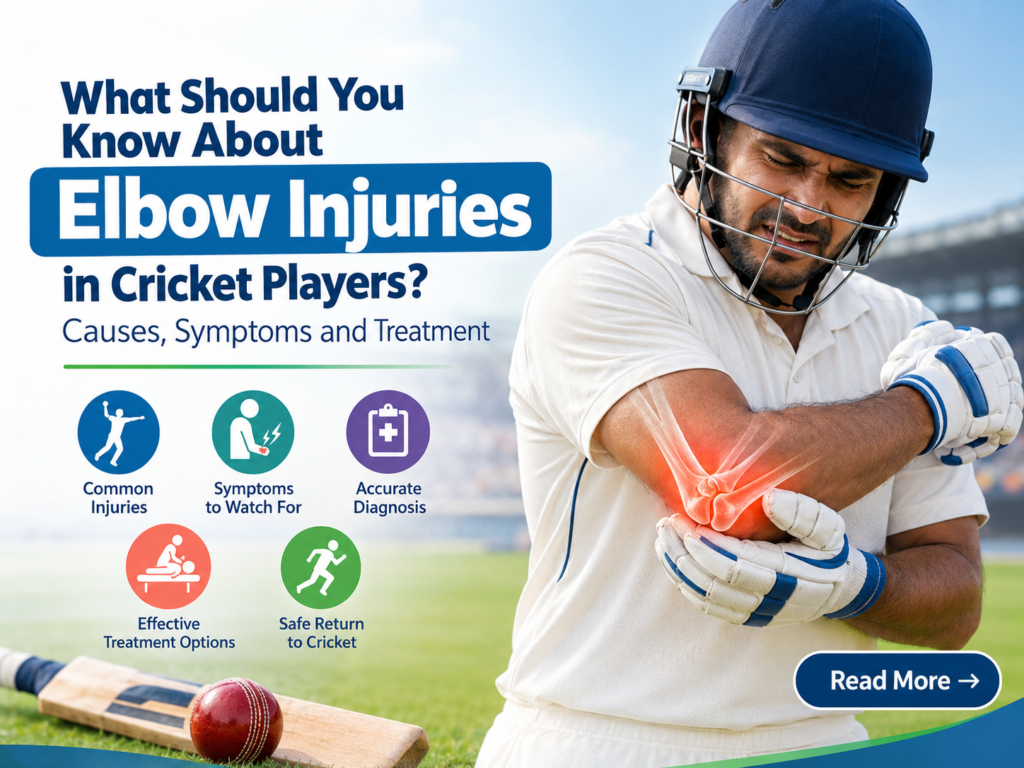
Why Are Elbow Injuries Common in Cricket Players?
Cricket requires repeated arm movements, strong gripping, powerful throwing, and controlled bowling actions. These activities place stress on the elbow joint, forearm muscles, tendons, and ligaments.
Fast bowlers may experience strain from repetitive bowling, while batsmen can develop elbow pain from repeated gripping and batting movements. Fielders may also injure their elbows while throwing the ball or diving to stop it.
Young cricketers, club-level players, professional athletes, and recreational players can all develop cricket-related elbow injuries. The risk may increase when training intensity rises suddenly, recovery time is inadequate, or playing technique places excessive stress on the joint.
Understanding the cause of elbow pain in cricketers is the first step towards selecting the right treatment.
Common Types of Elbow Injuries in Cricket Players
1. Tennis Elbow in Cricketers
Tennis elbow, medically known as lateral epicondylitis, affects the tendons attached to the outer side of the elbow. Despite its name, this condition can affect cricket players, especially batsmen who repeatedly grip and swing a bat.
Common symptoms include pain on the outer side of the elbow, discomfort while gripping the bat, pain when lifting objects, and reduced grip strength.
Early tennis elbow treatment in Nagpur may involve activity modification, appropriate pain management, physiotherapy, and progressive strengthening exercises. Persistent cases may require further investigation and specialist treatment.
2. Golfer’s Elbow in Cricket Players
Golfer’s elbow, also called medial epicondylitis, affects the tendons attached to the inner side of the elbow. Repeated gripping, wrist bending, and forceful arm movements can contribute to this condition.
A cricketer may experience pain while batting, throwing, lifting equipment, or performing wrist movements. In some cases, discomfort can spread down the forearm.
Golfer’s elbow treatment depends on the severity of tendon damage and the player’s symptoms. Rest from painful activities and a guided rehabilitation programme are often important parts of recovery.
3. Elbow Ligament Injuries in Fast Bowlers
Fast bowling involves repeated high-speed movements that place considerable forces on the elbow. The ligaments help maintain joint stability, and excessive repetitive stress can injure them.
Symptoms may include pain on the inner side of the elbow, discomfort during bowling, reduced performance, and difficulty straightening the arm.
An elbow ligament injury should not be ignored, particularly when pain returns during every bowling session. A sports injury doctor in Nagpur can assess the joint and determine whether further investigations or specialised treatment are needed.
4. Elbow Fractures and Dislocations
A fall while fielding, a direct impact from the ball, or an awkward landing can cause an elbow fracture or dislocation.
These injuries may produce severe pain, swelling, bruising, deformity, or difficulty moving the arm. Some injuries can also affect nearby nerves and blood vessels.
Seek urgent medical attention if a serious elbow injury occurs. Do not attempt to straighten a deformed joint or put a dislocated elbow back into position yourself.
5. Elbow Overuse Injuries in Young Cricketers
Young players may develop elbow problems when they bowl too frequently or increase their training workload too quickly. In growing children, repetitive stress can sometimes affect the growth area of the bone near the elbow.
Persistent pain during bowling, tenderness around the joint, or declining performance should prompt medical assessment. Young players should not be encouraged to continue bowling through pain.
What Are the Warning Signs of an Elbow Injury?
The symptoms depend on the injured structure and the severity of the condition.
Common warning signs include:
- Pain during batting, bowling, or throwing.
- Tenderness on the inner or outer side of the elbow.
- Swelling or bruising after an injury.
- Difficulty bending or straightening the arm.
- Weak grip while holding a cricket bat.
- Clicking, catching, or locking of the joint.
- Tingling or numbness in the fingers.
- Pain that returns whenever training resumes.
Sudden severe pain, visible deformity, major swelling, or a cold, pale or numb hand requires urgent assessment. Persistent pain should also be evaluated rather than repeatedly managed with painkillers.
How Are Cricket-Related Elbow Injuries Diagnosed?
Accurate diagnosis helps prevent unnecessary treatment and supports a safer return to cricket.
Medical History and Physical Examination
An orthopaedic specialist may ask when the pain started, which cricket activity triggers it, whether an injury occurred, and how the symptoms affect everyday activities.
The examination may assess elbow movement, tenderness, joint stability, grip strength, and nerve function.
Imaging When Required
An X-ray may be recommended when a fracture, dislocation, or bone-related problem is suspected. Ultrasound or MRI may help assess tendons, ligaments, and other soft tissues when clinically indicated.
Not every patient requires imaging. The choice depends on the injury, examination findings, and medical history.
What Is the Best Treatment for Elbow Injuries in Cricketers?
There is no single treatment suitable for every elbow injury. The correct approach depends on the diagnosis, severity, sporting demands, and recovery progress.
1. Rest and Activity Modification
Temporarily reducing or stopping the painful cricket activity can help prevent further strain. A player with significant pain should not continue fast bowling or forceful throwing simply to maintain practice.
Rest does not always mean keeping the entire arm completely still. The appropriate level of movement depends on the injury and medical advice.
2. Physiotherapy and Rehabilitation
A supervised rehabilitation programme may include gentle mobility exercises, progressive forearm strengthening, grip training, and exercises to improve movement control.
The programme should be adjusted to the specific injury. Starting aggressive exercises too early may worsen symptoms, particularly after a ligament injury or fracture.
3. Medicines and Other Treatments
A doctor may recommend suitable pain-relieving medicines or other treatments after assessing the patient’s condition and medical history. Braces or supports may be appropriate for selected injuries.
Injections or other procedures should only be considered after discussing their potential benefits, risks, and suitability. They are not necessary for every case of tennis elbow or golfer’s elbow.
4. Surgery for Selected Injuries
Surgery may be considered for certain fractures, unstable injuries, significant structural damage, or persistent tendon problems that do not respond to appropriate non-surgical treatment.
Elbow arthroscopy is a minimally invasive procedure that uses a small camera and specialised instruments inside the joint. It may be suitable for selected elbow conditions, but it is not required for routine elbow pain.
Elbow joint replacement is reserved for specific cases involving substantial joint damage. It is not a standard treatment for common cricket-related tendon injuries.
How Can Cricketers Prevent Elbow Injuries?
Prevention starts with good technique, sensible training, and adequate recovery.
- Increase bowling and throwing workloads gradually.
- Follow age-appropriate coaching and workload guidance.
- Warm up before practice and matches.
- Strengthen the forearm, shoulder, and upper-arm muscles under proper guidance.
- Use suitable equipment and avoid excessive gripping force.
- Allow adequate recovery between demanding sessions.
- Stop and seek advice when pain repeatedly returns.
- Return to competitive cricket only when the injury has recovered sufficiently.
A player should not return to full-intensity bowling merely because pain has reduced. Movement, strength, function, and sport-specific readiness should be assessed before resuming unrestricted play.
Why Consult an Orthopaedic Specialist for Elbow Pain in Nagpur?
Elbow injuries can affect batting performance, bowling speed, throwing accuracy, and everyday activities. Treating every elbow problem as simple muscle pain may delay the diagnosis of a tendon, ligament, bone, or joint injury.
Dr. Vishal Sahni is an Orthopaedic Surgeon specialising in shoulder, elbow, and wrist conditions. His qualifications include MBBS, MS ORTHO, FRCS ORTHO (London), and MCh ORTHO (Liverpool).
At London Orthopaedic Clinic, Nagpur, patients can seek assessment for elbow pain, tennis elbow, sports injuries, and other upper-limb conditions. Treatment recommendations depend on individual examination findings and may include non-surgical management, rehabilitation, or surgery when appropriate.
The clinic also provides care for related conditions, including tennis elbow and elbow pain, shoulder injuries, and wrist problems. These links can help patients learn more about related upper-limb conditions.
Consult Dr. Vishal Sahni at London Orthopaedic Clinic, Nagpur
Cricketers experiencing persistent elbow pain, restricted movement, or repeated injuries should seek professional advice before returning to intensive training. Early assessment can help identify the problem and guide an appropriate recovery plan.
Dr. Vishal Sahni
Orthopaedic Surgeon | Shoulder, Elbow & Wrist Specialist
Qualifications: MBBS, MS ORTHO, FRCS ORTHO (London), MCh ORTHO (Liverpool)
London Orthopaedic Clinic
Ground Floor, Berar House, Mehadia Square, Dhantoli, Nagpur, Maharashtra 440012, India.
Mobile / WhatsApp: +91 9529552938
Website: https://londonorthopaedicclinicngp.com/
Directions: Find the clinic on Google Maps
Online consultation available.
Patients from Nagpur and other parts of Central India can enquire about appointments. This includes people travelling from Jabalpur, Bhopal, Seoni, Chhindwara, Indore, Raipur, Wardha, Amravati, Chandrapur, Yavatmal, Pune, and Mumbai, as well as other locations across Maharashtra, Madhya Pradesh, and Chhattisgarh. Online consultation may help patients discuss their symptoms and available reports, although some injuries require an in-person examination.
Protect your game by protecting your elbow. If pain is affecting your batting, bowling, throwing, or daily activities, consult an orthopaedic specialist for an accurate diagnosis and an individualised treatment plan.
Frequently Asked Questions About Elbow Injuries in Cricket Players
1. What are the most common elbow injuries in cricket players?
The most common elbow problems in cricket players include tennis elbow, golfer’s elbow, tendon injuries, ligament injuries and elbow fractures or dislocations. These conditions may develop due to repetitive bowling, batting, throwing or a direct impact during a match. The correct treatment depends on the type and severity of the injury.
2. Why does my elbow hurt after playing cricket?
Elbow pain after playing cricket may occur due to overuse, repetitive gripping, incorrect technique, tendon irritation or ligament strain. Fast bowlers and batsmen may experience different types of elbow problems. If pain persists, returns during every practice session, or affects arm movement, consult an orthopaedic specialist for an accurate diagnosis.
3. Can fast bowling cause elbow injuries?
Yes. Fast bowling places repeated stress on the elbow, particularly when training workloads increase rapidly or recovery time is insufficient. Some bowlers develop tendon or ligament problems, while young players may be vulnerable to growth-related injuries. Appropriate coaching, workload management and early assessment of persistent pain can help reduce complications.
4. What is tennis elbow in cricket players?
Tennis elbow, also known as lateral epicondylitis, affects the tendons on the outer side of the elbow. Cricket players may develop this condition through repeated gripping, batting and wrist movements. Symptoms include outer elbow pain, weak grip and discomfort when lifting objects. Treatment may involve activity modification, physiotherapy and other measures recommended by a doctor.
5. What is the difference between tennis elbow and golfer’s elbow?
Tennis elbow generally causes pain on the outer side of the elbow, whereas golfer’s elbow causes pain on the inner side. Both conditions can result from repetitive movements and tendon overload. A clinical examination helps distinguish between them and determine the most suitable treatment.
6. When should a cricketer see an elbow pain doctor in Nagpur?
A cricketer should consult an elbow pain doctor in Nagpur if pain persists, repeatedly returns during bowling or batting, or causes weakness or restricted movement. Severe swelling, visible deformity, sudden intense pain, or numbness and coldness in the hand require urgent medical assessment.
7. How are elbow injuries in cricket players diagnosed?
Diagnosis usually involves reviewing the injury history and examining elbow movement, tenderness, stability, grip strength and nerve function. An X-ray may be needed when a fracture is suspected. Ultrasound or MRI may help assess tendon and ligament injuries when indicated by the clinical findings.
8. What is the best treatment for elbow injuries in cricketers?
The best treatment depends on the specific injury. Options may include temporary activity modification, suitable pain relief, physiotherapy, progressive strengthening and, for selected serious injuries, surgery. A sports injury doctor can recommend an individualised treatment plan after assessing the elbow.
9. Can tennis elbow heal without surgery?
Yes. Many cases of tennis elbow improve without surgery through activity modification, appropriate rehabilitation and gradual strengthening. Recovery time varies depending on symptom duration, severity and adherence to treatment. Surgery is generally considered only for selected persistent cases after appropriate non-surgical treatment has been unsuccessful.
10. How long does an elbow injury take to heal in a cricketer?
Recovery may take several weeks for some mild conditions, while significant ligament injuries, fractures and surgical cases may require several months or longer. The timeline depends on the diagnosis, injury severity and individual healing. Returning to cricket should be based on functional recovery and medical guidance, not pain reduction alone.
11. Can I continue playing cricket if my elbow hurts?
Continuing to play through elbow pain may worsen some injuries. Reduce or stop the activity that triggers the pain and seek medical advice if symptoms persist. Severe pain, swelling, weakness or restricted movement should not be ignored. Return to full training when your elbow has recovered sufficiently and you have been appropriately assessed.
12. Can elbow ligament injuries in fast bowlers require surgery?
Some elbow ligament injuries improve with suitable non-surgical treatment and rehabilitation. Surgery may be considered in selected cases involving significant instability, structural damage or persistent symptoms that prevent sporting activity. The decision depends on the injured ligament, the player’s sporting requirements and clinical examination findings.
13. How can cricketers prevent elbow injuries?
Cricketers can reduce injury risk by increasing training workloads gradually, following appropriate bowling guidance, warming up properly, improving technique, strengthening relevant muscles and allowing enough recovery between demanding sessions. Persistent pain should be assessed early rather than repeatedly managed with painkillers.
14. Can children and young cricketers develop elbow injuries?
Yes. Young cricketers can develop elbow pain due to repetitive bowling, overtraining or injuries affecting growing bones. Persistent pain during bowling deserves prompt assessment. Coaches and parents should avoid encouraging young players to continue intensive training when they have elbow pain.
15. Which doctor should I consult for cricket-related elbow pain?
An orthopaedic surgeon or sports medicine specialist with experience in elbow conditions can assess cricket-related elbow pain. The doctor may recommend rehabilitation, further investigations or specialist treatment according to the diagnosis. Patients seeking elbow pain treatment in Nagpur can enquire at London Orthopaedic Clinic.
16. Who is Dr. Vishal Sahni at London Orthopaedic Clinic, Nagpur?
Dr. Vishal Sahni is an orthopaedic surgeon specialising in shoulder, elbow and wrist conditions. He consults at London Orthopaedic Clinic in Dhantoli, Nagpur. Patients can enquire about assessment for elbow pain, tennis elbow, sports injuries and related upper-limb conditions.
17. What are Dr. Vishal Sahni’s educational qualifications?
Dr. Vishal Sahni’s qualifications include MBBS, MS ORTHO, FRCS ORTHO (London) and MCh ORTHO (Liverpool). These qualifications reflect his medical and orthopaedic training. Patients should discuss their specific condition, treatment choices, expected recovery and potential risks during consultation.
18. How much experience does Dr. Vishal Sahni have in orthopaedic treatment?
Clinic information describes Dr. Vishal Sahni as having more than 25 years of practice in the UK and India. Patients can contact London Orthopaedic Clinic to confirm current appointment availability and discuss his experience relevant to their particular elbow injury.
19. Does Dr. Vishal Sahni treat tennis elbow in Nagpur?
Patients can contact London Orthopaedic Clinic to enquire about assessment and treatment for tennis elbow. Management may include activity modification, rehabilitation, pain management and other appropriate options depending on the patient’s condition. The recommended approach is determined after clinical assessment.
20. Does London Orthopaedic Clinic treat sports injuries?
London Orthopaedic Clinic provides orthopaedic care for conditions involving the shoulder, elbow and wrist, including sports-related problems. Patients with elbow pain after cricket can enquire about an appointment to discuss their symptoms, diagnosis and suitable treatment options.
21. Is online consultation available with Dr. Vishal Sahni?
Yes, online consultation is available through London Orthopaedic Clinic. Patients can enquire about arranging an online appointment and sharing relevant medical reports or imaging. However, some injuries require a physical examination or urgent in-person assessment, particularly when a fracture, dislocation or serious ligament injury is suspected.
22. How can I book an appointment with Dr. Vishal Sahni in Nagpur?
You can contact London Orthopaedic Clinic by phone or WhatsApp at +91 9529552938 to enquire about appointments for elbow pain, tennis elbow and other orthopaedic conditions. You can also visit the clinic website at https://londonorthopaedicclinicngp.com/ for further information.
23. Where is London Orthopaedic Clinic located?
London Orthopaedic Clinic is located at Ground Floor, Berar House, Mehadia Square, Dhantoli, Nagpur, Maharashtra 440012, India. Patients can use Google Maps for directions: https://maps.app.goo.gl/unKK8xStAhwnEKL57.
24. Can patients from Jabalpur and Madhya Pradesh consult Dr. Vishal Sahni?
Patients from Jabalpur and other parts of Madhya Pradesh can contact London Orthopaedic Clinic in Nagpur to enquire about appointments for elbow injuries and other upper-limb conditions. Online consultation is also available. The suitability of online assessment depends on the symptoms and whether a physical examination