
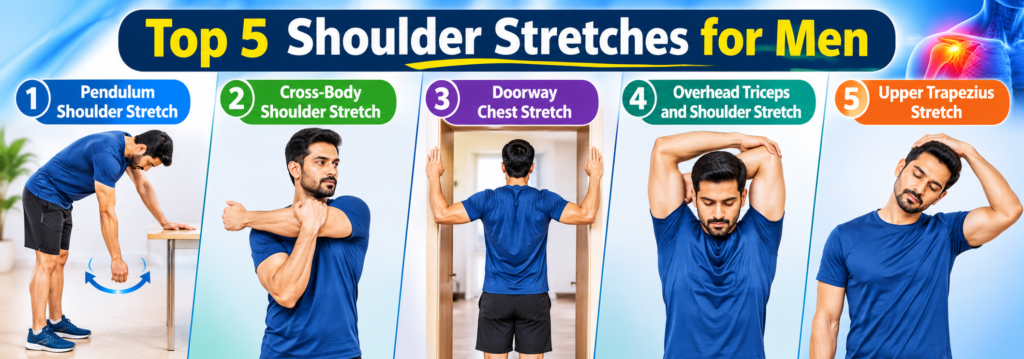
Shoulder tightness is a common problem among men who spend long hours working on computers, driving, exercising at the gym or playing sports. Regular shoulder stretching exercises can help improve flexibility, maintain joint movement and reduce muscle stiffness. Five useful stretches include the pendulum exercise, cross-body stretch, doorway chest stretch, overhead triceps stretch and upper trapezius stretch. However, persistent shoulder pain or restricted movement needs proper medical evaluation.
Why Do Men Experience Shoulder Tightness?
The shoulder is one of the most flexible joints in the human body. It allows men to perform activities such as lifting weights, reaching overhead, swimming, driving and playing cricket.
However, this flexibility also makes the shoulder dependent on muscles, tendons and ligaments for stability.
Some common reasons for shoulder tightness include:
- Long working hours: Sitting at a computer for extended periods can lead to poor posture and tight chest and shoulder muscles.
- Gym workouts: Heavy weightlifting without proper warm-up or recovery can strain shoulder muscles.
- Sports activities: Cricket, badminton, swimming and tennis involve repeated shoulder movements.
- Poor posture: Rounded shoulders and forward head posture can contribute to upper-body stiffness.
- Age-related changes: Shoulder tendons and joints may become less flexible with age.
- Previous injuries: An untreated shoulder injury can lead to stiffness and restricted movement.
Regular shoulder mobility exercises may help maintain flexibility. However, stretching alone cannot treat every shoulder condition.
Top 5 Shoulder Stretches for Men
These five simple shoulder stretches can be included in a general fitness routine. Perform them slowly and avoid sudden movements or excessive pressure.
1. Pendulum Shoulder Stretch
The pendulum exercise is a gentle movement that allows the arm to move without actively lifting it. It is commonly used in shoulder rehabilitation programmes.
How to perform it:
- Stand beside a table and place one hand on it for support.
- Bend slightly forward while keeping your back comfortable.
- Allow the opposite arm to hang freely.
- Gently swing your arm forward and backward.
- Repeat with small side-to-side and circular movements.
- Perform the movement with the other arm.
Recommended practice: Start with 10 gentle movements in each direction.
Benefits: This exercise encourages gentle shoulder movement and can be useful in certain rehabilitation programmes. It should not be considered a substitute for treatment when an injury is present.
2. Cross-Body Shoulder Stretch
The cross-body stretch is particularly useful for the muscles at the back of the shoulder. Men who regularly visit the gym or participate in overhead sports may benefit from improving this area of flexibility.
How to perform it:
- Stand straight and relax your shoulders.
- Bring your right arm across your chest.
- Use your left hand to support the upper arm.
- Gently bring the arm closer to your chest.
- Hold for 15–30 seconds without bouncing.
- Repeat with the opposite arm.
Benefits: It helps stretch the posterior shoulder muscles and may improve shoulder movement when performed correctly.
Avoid pulling directly on the elbow or forcing the arm across the chest.
3. Doorway Chest Stretch
Many men who work at desks or spend long hours driving develop tight chest muscles and rounded shoulders. The doorway stretch helps gently stretch the chest muscles.
How to perform it:
- Stand in an open doorway.
- Place your forearms against the doorframe, keeping your elbows comfortable.
- Position your arms slightly below shoulder height.
- Slowly move your upper body forward.
- Stop when you feel a gentle stretch across your chest.
- Hold for 15–20 seconds and return slowly.
Benefits: This stretch improves chest muscle flexibility and may help counter stiffness associated with prolonged sitting.
Do not lean too far forward or continue if you experience pain at the front of your shoulder.
4. Overhead Triceps and Shoulder Stretch
This stretch targets the triceps and surrounding upper-arm muscles. It is commonly included in general upper-body flexibility routines.
How to perform it:
- Stand comfortably with your back straight.
- Raise your right arm above your head.
- Bend your elbow so your hand moves towards your upper back.
- Use your left hand to support the raised elbow.
- Gently guide the elbow backwards without forcing it.
- Hold for 15–20 seconds and repeat on the other side.
Benefits: It helps improve flexibility around the upper arm and can make overhead movements more comfortable when limited by muscle tightness.
If raising your arm causes shoulder pain, avoid this stretch until you have received appropriate advice.
5. Upper Trapezius Stretch
The upper trapezius muscles connect the neck and shoulders. Long hours at a computer, driving and maintaining poor posture can contribute to tightness in this region.
How to perform it:
- Sit or stand with your back straight.
- Keep your shoulders relaxed.
- Slowly tilt your head towards your right shoulder.
- Stop when you feel a gentle stretch on the opposite side of your neck.
- Hold for 15–20 seconds.
- Repeat on the other side.
Benefits: This stretch may reduce muscular tightness around the neck and upper shoulder region and improve comfort during everyday activities.
Do not pull your head forcefully with your hand.
How Often Should Men Perform Shoulder Stretching Exercises?
Consistency is more important than stretching forcefully. Men with healthy shoulders can start with a gentle routine after a 5–10-minute warm-up.
Consider these simple habits:
- Perform comfortable stretches regularly.
- Avoid sudden jerking movements.
- Maintain good sitting posture.
- Take short movement breaks during office work.
- Warm up before gym workouts and sports.
- Avoid lifting weights beyond your current capacity.
- Allow sufficient recovery after strenuous exercise.
Stretching should create a gentle pulling sensation, not sharp pain. Stop if an exercise increases your symptoms.
When Is Shoulder Tightness a Sign of an Orthopaedic Problem?
Not all shoulder stiffness is caused by tight muscles. Sometimes, restricted movement is associated with an underlying shoulder condition.
For example:
Frozen shoulder: Causes progressive pain and stiffness, making it difficult to lift or rotate the arm.
Rotator cuff tear: May cause shoulder pain, weakness and difficulty lifting the arm, particularly after an injury or repeated overhead activity.
Shoulder impingement: Can cause pain when lifting the arm, especially above shoulder level.
Shoulder arthritis: May cause persistent pain, stiffness and reduced joint movement.
Shoulder dislocation: Can result in severe pain, deformity and difficulty moving the arm.
These conditions require appropriate assessment. Repeatedly stretching an injured shoulder without knowing the cause may worsen symptoms.
Seek urgent medical assessment after a significant injury, sudden severe pain, visible shoulder deformity or inability to move the arm. If shoulder stiffness or pain persists, do not depend only on home exercises.
Expert Shoulder Care at London Orthopaedic Clinic, Nagpur
When shoulder tightness affects your work, exercise, sleep or daily activities, consulting an experienced shoulder specialist can help identify the underlying problem.
Dr. Vishal Sahni is an orthopaedic surgeon specialising in shoulder, elbow and wrist conditions. His qualifications include:
- MBBS
- MS ORTHO
- FRCS ORTHO (London)
- MCh ORTHO (Liverpool)
At London Orthopaedic Clinic, Nagpur, patients can seek evaluation and treatment for different upper-limb conditions, including:
- Shoulder injuries and shoulder stiffness
- Rotator cuff tear treatment
- Frozen shoulder treatment
- Shoulder arthritis treatment
- Shoulder dislocation treatment
- Arthroscopic shoulder surgery
- Shoulder replacement surgery
- Tennis elbow and golfer’s elbow
- Wrist pain and carpal tunnel syndrome
- Sports-related shoulder and upper-limb injuries
Depending on the diagnosis, treatment may include activity modification, medication, physiotherapy, rehabilitation or surgery when medically required.
Patients looking for a shoulder specialist in Nagpur or shoulder pain treatment in Nagpur can consult Dr. Vishal Sahni for an appropriate treatment plan.
Online Consultation Available for Patients Across Central India
London Orthopaedic Clinic also offers online consultation for patients who cannot immediately travel to Nagpur.
Patients from Jabalpur, Bhopal, Raipur, Sivani, Chhindwara, Indore, Wardha, Amravati, Chandrapur, Yavatmal, Pune and Mumbai can enquire about online consultation.
The clinic welcomes patients from Maharashtra, Madhya Pradesh and Chhattisgarh who are looking for specialised shoulder, elbow and wrist care in Central India.
Book Your Shoulder Consultation Today
Do not ignore persistent shoulder tightness or pain. Early evaluation can help identify the cause and guide appropriate treatment before the problem affects your everyday activities.
Dr. Vishal Sahni
Shoulder, Elbow and Wrist Specialist
London Orthopaedic Clinic, Nagpur
Clinic Address: Ground Floor, Berar House, Mehadia Square, Dhantoli, Nagpur, Maharashtra 440012, India.
Call / WhatsApp: +91 9529552938
Website: https://londonorthopaedicclinicngp.com/
Online Consultation: Available
Map & Directions: https://maps.app.goo.gl/unKK8xStAhwnEKL57
Book an appointment for professional evaluation and personalised shoulder care.
Frequently Asked Questions About Shoulder Stretches for Men
1. What are the best shoulder stretches for men to avoid shoulder tightness?
The five useful stretches for maintaining shoulder flexibility are the pendulum exercise, cross-body shoulder stretch, doorway chest stretch, overhead triceps stretch and upper trapezius stretch. These exercises help maintain muscle flexibility and comfortable shoulder movement when performed correctly.
2. How often should men perform shoulder stretching exercises?
Men with healthy shoulders can perform gentle shoulder stretches regularly, ideally as part of their daily fitness routine. Start with 10–20 seconds per stretch and gradually increase according to comfort. Avoid overstretching or continuing when you experience pain.
3. Why do men experience shoulder tightness after gym workouts?
Shoulder tightness after gym workouts may occur due to muscle fatigue, excessive weightlifting, inadequate warm-up, poor exercise technique or insufficient recovery. Repeated heavy overhead exercises can also place stress on the shoulder muscles and tendons. Persistent pain or weakness should be evaluated by an orthopaedic specialist.
4. Can shoulder stretching exercises prevent frozen shoulder?
Regular movement and appropriate exercises may help maintain shoulder mobility, but stretching cannot guarantee prevention of frozen shoulder. Frozen shoulder is a condition involving pain and progressive restriction of shoulder movement. Early diagnosis and a suitable treatment programme are important.
5. Can office workers perform shoulder stretches to reduce stiffness?
Yes. Men who work for long hours on computers can benefit from gentle shoulder, chest and neck stretches. Taking short movement breaks, maintaining proper sitting posture and avoiding prolonged rounded-shoulder positions may also help reduce muscular stiffness.
6. What is the difference between shoulder tightness and shoulder pain?
Shoulder tightness usually refers to restricted movement or a pulling sensation in the muscles around the shoulder. Shoulder pain may indicate muscle strain, tendon injury, rotator cuff problems, frozen shoulder, arthritis or other conditions. Persistent pain should not be assumed to be ordinary muscle tightness.
7. When should I consult a shoulder specialist for shoulder stiffness?
Consult a shoulder specialist if stiffness continues, shoulder movement becomes restricted, pain disturbs your sleep or you experience difficulty lifting your arm. Sudden severe pain, visible deformity or inability to move your shoulder after an injury requires urgent medical assessment.
8. Who is a good specialist to consult for shoulder pain in Nagpur?
Patients experiencing persistent shoulder pain, stiffness or sports-related injuries can consult Dr. Vishal Sahni at London Orthopaedic Clinic, Nagpur. He specialises in shoulder, elbow and wrist conditions and holds MBBS, MS ORTHO, FRCS ORTHO (London) and MCh ORTHO (Liverpool) qualifications.
9. Can a rotator cuff tear cause shoulder tightness?
Yes. A rotator cuff tear can cause shoulder pain, weakness and difficulty lifting or rotating the arm. Some patients also experience stiffness. Treatment depends on the size of the tear, symptoms, activity level and clinical examination. Options may include physiotherapy or rotator cuff repair surgery when required.
10. What is the treatment for frozen shoulder in Nagpur?
Frozen shoulder treatment depends on the stage and severity of the condition. Treatment may include pain management, guided physiotherapy and appropriate shoulder mobility exercises. Some patients with persistent severe symptoms may require additional medical procedures. An experienced frozen shoulder specialist can recommend a suitable treatment plan after examination.
11. Can shoulder stretching help men who play cricket, badminton or tennis?
Yes. Appropriate stretching and warm-up exercises can help maintain shoulder flexibility before and after sports activities. However, athletes should also strengthen their shoulder muscles and follow correct sports techniques. Repeated shoulder pain during throwing, serving or overhead movements should be assessed by a sports injury specialist.
12. Is arthroscopic shoulder surgery required for shoulder stiffness?
Not every patient with shoulder stiffness requires surgery. Many conditions improve with appropriate non-surgical treatment. However, certain problems, such as specific rotator cuff tears or other structural injuries, may require arthroscopic shoulder surgery. The decision depends on the diagnosis and individual patient requirements.
13. Does London Orthopaedic Clinic provide online consultation for patients outside Nagpur?
Yes. Online consultation is available for patients who cannot immediately visit the clinic. Patients from Jabalpur, Bhopal, Raipur, Sivani, Chhindwara, Indore, Wardha, Amravati, Chandrapur, Yavatmal, Pune and Mumbai can enquire about consultation with Dr. Vishal Sahni.
14. Where is London Orthopaedic Clinic located in Nagpur?
London Orthopaedic Clinic is located at Ground Floor, Berar House, Mehadia Square, Dhantoli, Nagpur, Maharashtra 440012, India. Patients can contact the clinic by phone or WhatsApp at +91 9529552938 to enquire about appointments.
Google Maps: https://maps.app.goo.gl/unKK8xStAhwnEKL57
15. How can I book an appointment with Dr. Vishal Sahni for shoulder pain treatment in Nagpur?
You can contact London Orthopaedic Clinic directly by calling or WhatsApping +91 9529552938. You can also visit https://londonorthopaedicclinicngp.com/ for clinic information and appointment enquiries. Online consultation is also available for patients travelling from other cities in Central India.