
Shoulder pain can quietly change your everyday life.
A shirt that was easy to wear becomes difficult to button. Reaching for something on a shelf hurts. Sleeping on one side becomes uncomfortable. You may even start avoiding exercise, driving or simple household activities.
But here is the important point: shoulder pain is a symptom, not a diagnosis.
A painful shoulder may be caused by a rotator cuff tear, frozen shoulder, arthritis, instability, tendon problems, an injury or another condition. Therefore, the right treatment depends on finding the actual cause first.
Today, shoulder treatment has moved far beyond simply taking painkillers and waiting.
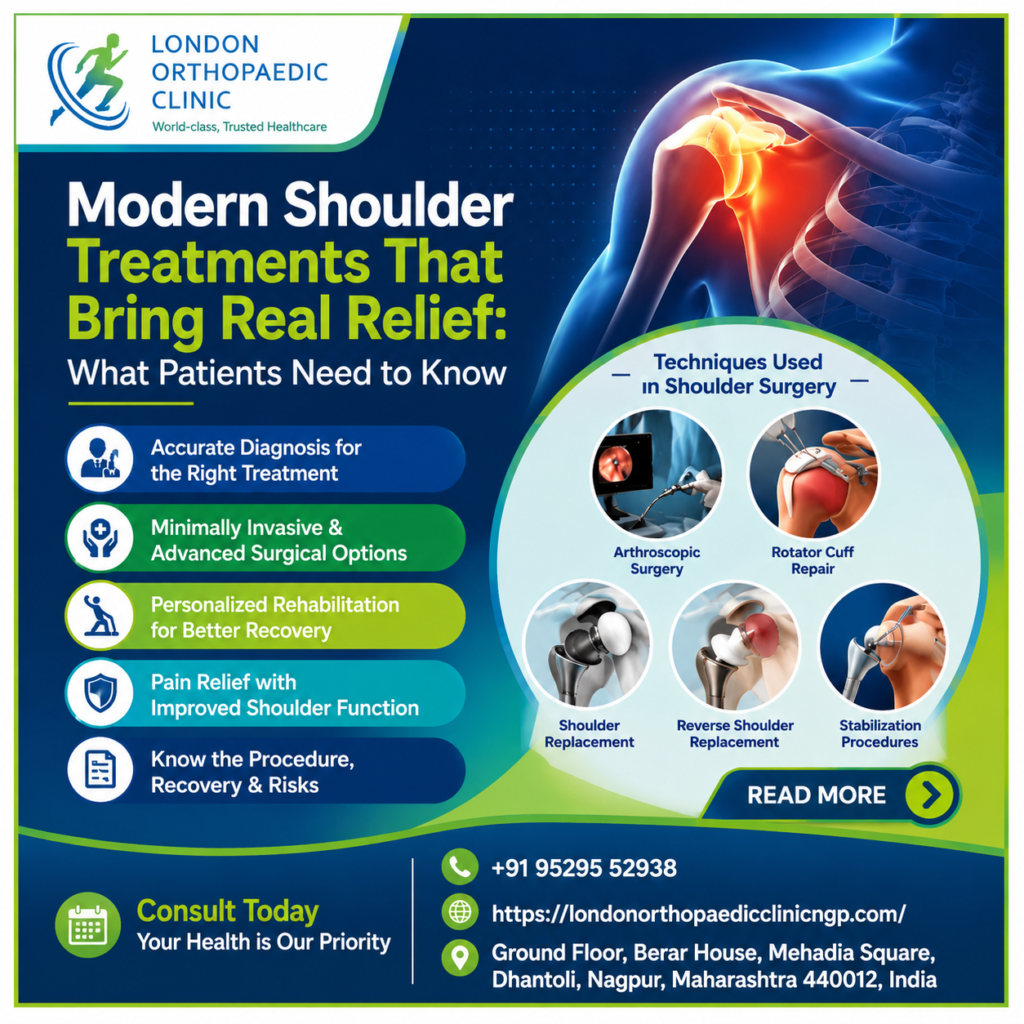
Modern orthopaedic care combines accurate diagnosis, targeted non-surgical treatment, rehabilitation and, when necessary, advanced procedures such as arthroscopic surgery or shoulder replacement.
What Is the Best Treatment for Shoulder Pain?
There is no single treatment that is best for every patient.
For some people, physiotherapy and activity modification may be enough. Others may benefit from medication or an injection. Patients with significant tendon damage, instability or advanced arthritis may require surgery.
The first step is therefore a proper clinical assessment.
A shoulder specialist may assess your range of movement, strength, pain pattern and shoulder stability. Depending on your symptoms, imaging such as an X-ray, ultrasound or MRI may also be recommended.
This approach helps avoid treating only the pain while missing the actual problem.
1. Personalised Non-Surgical Shoulder Treatment
Modern shoulder care does not automatically mean surgery.
In many cases, treatment begins with non-surgical options such as:
- Activity modification
- Guided physiotherapy
- Shoulder-strengthening exercises
- Medicines when appropriate
- Pain and inflammation management
- Selected injections
- Gradual return to normal activities
The goal is not simply to reduce pain for a few days. It is to improve shoulder function and help you return to daily activities safely.
For example, frozen shoulder treatment may involve pain control, gentle movement, exercises and physiotherapy. In selected patients, a specialist may consider an injection or another intervention when symptoms remain troublesome.
Internal link opportunity:
Frozen Shoulder Treatment → Link to your dedicated Frozen Shoulder Treatment page
2. Modern Treatment for Rotator Cuff Tears
The rotator cuff is a group of tendons that helps lift and rotate the arm.
A tear can develop because of ageing and tendon wear, repeated overhead activity or an injury such as a fall or shoulder dislocation. Not every rotator cuff tear requires immediate surgery. Treatment depends on the patient’s symptoms, activity level, tear characteristics and overall health.
For suitable patients, treatment may include physiotherapy and rehabilitation. When surgery is appropriate, arthroscopic rotator cuff repair can be considered.
What is arthroscopic shoulder surgery?
Arthroscopic surgery uses a small camera and specialised instruments through small openings around the shoulder.
Depending on the problem, arthroscopy may be used for procedures such as:
- Rotator cuff repair
- Treatment of shoulder instability
- Labral repair
- Selected treatment of sports injuries
- Other problems inside the shoulder joint
The exact procedure depends on the diagnosis.
Internal link opportunity:
Rotator Cuff Tear Treatment in Nagpur → Link to your rotator cuff treatment page
3. Frozen Shoulder: Restoring Movement, Not Just Reducing Pain
Frozen shoulder, also known as adhesive capsulitis, can cause significant pain and progressive stiffness.
Patients often notice difficulty reaching behind the back, lifting the arm or performing simple activities such as dressing.
The condition can take months or longer to settle, so treatment needs patience and a structured approach.
A frozen shoulder specialist in Nagpur can help determine whether the symptoms are truly due to frozen shoulder or another condition that may look similar.
Treatment may focus on controlling pain and gradually restoring movement.
Internal link opportunity:
Frozen Shoulder Specialist in Nagpur → Link to your frozen shoulder page
4. Shoulder Dislocation and Instability Treatment
A shoulder dislocation is more than a painful event that needs to be “put back”.
In some patients, particularly after repeated dislocations, the supporting structures of the shoulder may become damaged or stretched.
Treatment depends on factors such as age, activity level, previous dislocations and associated injuries.
A patient with repeated instability may need specialist assessment to determine whether rehabilitation alone is appropriate or whether a stabilisation procedure should be considered.
Internal link opportunity:
Shoulder Dislocation Treatment in Nagpur → Link to your shoulder dislocation page
5. Shoulder Arthritis and Shoulder Replacement
When the cartilage of the shoulder joint becomes severely damaged, patients may experience persistent pain, stiffness and loss of function.
If conservative treatment no longer provides adequate relief and arthritis is significantly affecting daily life, shoulder replacement surgery in Nagpur may be considered.
There are different forms of shoulder replacement.
A conventional shoulder replacement aims to reproduce the natural ball-and-socket arrangement. A reverse shoulder replacement changes the arrangement of the joint and may be useful in selected patients, including some with severe rotator cuff damage.
The decision depends on the condition of the joint, rotator cuff, bones, age, activity level and other individual factors.
Internal link opportunity:
Shoulder Replacement Surgery → Link to your shoulder replacement page
Reverse Shoulder Replacement Surgery → Link to your reverse shoulder replacement page
6. Modern Minimally Invasive Shoulder Surgery
One major development in orthopaedics is the use of minimally invasive and arthroscopic techniques for appropriate conditions.
These techniques can allow the surgeon to work inside the shoulder through small incisions rather than using a large traditional opening.
However, minimally invasive does not mean that every shoulder problem should be treated with keyhole surgery.
The correct procedure depends on the diagnosis.
A good surgical plan starts with understanding the patient’s problem, not simply choosing the newest technology.
Does Every Shoulder Problem Need Surgery?
No.
This is one of the most important things patients should understand.
Many shoulder conditions can initially be managed without surgery. On the other hand, delaying appropriate treatment for a significant injury may not always be beneficial.
The decision should be based on:
- The exact diagnosis
- Severity of symptoms
- Duration of the problem
- Age and activity level
- Previous treatment
- Imaging findings
- Functional requirements
- Overall health
A shoulder specialist can explain both surgical and non-surgical choices so that the patient can make an informed decision.
When Should You See a Shoulder Specialist?
Consider specialist assessment if:
- Shoulder pain continues or keeps returning
- You have difficulty lifting your arm
- Pain regularly disturbs your sleep
- Your shoulder has become increasingly stiff
- You have weakness while lifting
- You have suffered a shoulder injury
- Your shoulder has dislocated
- You have persistent pain despite physiotherapy
- You have been diagnosed with a rotator cuff tear or arthritis
Sudden severe shoulder pain, inability to move the arm, visible deformity or severe pain following an injury requires prompt medical evaluation.
Why Choose a Shoulder Specialist in Nagpur?
When patients search for an orthopedic surgeon near me, the most important question should not simply be “Who is closest?”
Look for relevant qualifications, experience, specialist focus and a treatment approach that matches your condition.
Dr. Vishal Sahni is a Shoulder, Elbow & Wrist Specialist practising at London Orthopaedic Clinic, Nagpur. His qualifications include:
MBBS | MS ORTHO | FRCS ORTHO (London) | MCh ORTHO (Liverpool)
He has more than 24 years of experience in India and the UK and focuses on shoulder, elbow and wrist conditions.
At London Orthopaedic Clinic, patients can seek assessment for shoulder injuries, rotator cuff tears, frozen shoulder, shoulder dislocation, shoulder arthritis, sports injuries and conditions requiring shoulder replacement.
The clinic also provides care for other upper-limb problems, including tennis elbow, elbow pain and wrist conditions.
Patients looking for a tennis elbow treatment in Nagpur, elbow pain doctor in Nagpur or wrist pain treatment in Nagpur can also seek specialist assessment.
Advanced Shoulder Care for Patients Across Central India
Patients do not always live in Nagpur.
Dr. Vishal Sahni and London Orthopaedic Clinic receive enquiries from patients across Central India and nearby regions, including Jabalpur, Bhopal, Raipur, Seoni, Chhindwara, Wardha, Amravati, Chandrapur and Yavatmal.
Online consultation is also available, which can be useful for patients who are unable to travel immediately or want an initial expert opinion.
The Goal Is Better Movement, Not Just Less Pain
Modern shoulder treatment is not about choosing the most expensive or most advanced procedure.
It is about choosing the right treatment for the right patient at the right time.
Sometimes that means physiotherapy.
Sometimes it means an injection or structured rehabilitation.
Sometimes a rotator cuff repair, stabilisation procedure or arthroscopic shoulder surgery is appropriate.
And for advanced joint damage, shoulder replacement may provide a pathway towards better function and reduced pain.
If shoulder pain is affecting your sleep, work, exercise or everyday life, do not keep guessing the cause.
Get the shoulder properly assessed and understand your treatment options.
Consult Dr. Vishal Sahni – Shoulder, Elbow & Wrist Specialist
London Orthopaedic Clinic
Ground Floor, Berar House,
Mehadia Square, Dhantoli,
Nagpur, Maharashtra 440012, India
Mobile / WhatsApp: +91 9529552938
Online Consultation: Available
Website: londonorthopaedicclinicngp.com
If you are searching for a shoulder specialist in Nagpur, shoulder surgeon in Nagpur, shoulder pain doctor in Nagpur, shoulder joint specialist in Nagpur or an upper limb surgeon in Nagpur, a specialist consultation can help you understand what is actually causing your symptoms and which treatment may be appropriate.
Your shoulder deserves a diagnosis—not just a painkiller.
Frequently Asked Questions About Modern Shoulder Treatments
1. What is the best treatment for shoulder pain?
The best treatment depends on the cause of shoulder pain. Some patients improve with medicines, physiotherapy, activity modification or injections, while others may need arthroscopic surgery or shoulder replacement. A proper examination and, when required, imaging can help identify the right treatment.
2. When should I see a shoulder specialist in Nagpur?
You should consider seeing a shoulder specialist if pain continues for several weeks, keeps returning, affects sleep, causes weakness or stiffness, or makes everyday activities difficult. You should also seek specialist care after a significant shoulder injury or dislocation.
3. Does shoulder pain always require surgery?
No. Many shoulder problems can be treated without surgery. Surgery is generally considered when symptoms are severe, a significant structural problem is present, or appropriate non-surgical treatment has not provided sufficient improvement.
4. What is arthroscopic shoulder surgery?
Arthroscopic shoulder surgery is a minimally invasive procedure in which a small camera and specialised instruments are inserted through small incisions around the shoulder. Depending on the diagnosis, it may be used for rotator cuff repair, instability, labral problems and selected sports injuries.
5. What is the treatment for a rotator cuff tear?
Rotator cuff tear treatment depends on the size and type of tear, symptoms, age, activity level and other factors. Treatment may include physiotherapy and rehabilitation. Some patients with significant tears may require surgical repair, including arthroscopic rotator cuff repair.
6. What is the treatment for frozen shoulder?
Frozen shoulder treatment usually focuses on controlling pain and gradually improving shoulder movement. Physiotherapy, exercises and medicines may be used. In selected cases, injections or procedures may be considered when symptoms remain severe or movement is significantly restricted.
7. When is shoulder replacement surgery needed?
Shoulder replacement may be considered when severe arthritis or other joint damage causes persistent pain and loss of function, particularly when non-surgical treatments are no longer providing adequate relief. The type of replacement depends on the condition of the shoulder joint and rotator cuff.
8. What is reverse shoulder replacement surgery?
Reverse shoulder replacement changes the normal arrangement of the shoulder joint, placing the artificial ball and socket in the opposite positions. It may be suitable for selected patients with severe shoulder arthritis combined with major rotator cuff damage or other complex shoulder problems.
9. Can a shoulder dislocation be treated without surgery?
Some first-time shoulder dislocations can initially be managed with reduction, immobilisation and rehabilitation. However, repeated dislocations or associated structural damage may require specialist assessment and, in selected patients, stabilisation surgery.
10. How do I choose a shoulder surgeon in Nagpur?
Look for a specialist with relevant qualifications, experience in shoulder conditions and a treatment approach based on accurate diagnosis. It is also useful to understand both non-surgical and surgical options before making a treatment decision.
11. Can shoulder arthritis cause stiffness and pain?
Yes. Shoulder arthritis can cause pain, stiffness, reduced range of movement and difficulty with activities such as reaching, dressing or lifting objects. Treatment depends on the severity of joint damage and the patient’s symptoms.
12. Can I get an online consultation for shoulder pain?
Yes. London Orthopaedic Clinic provides online consultation options. This can help patients discuss their symptoms and available reports with a specialist before deciding whether an in-person examination is required.
13. Do patients from outside Nagpur consult Dr. Vishal Sahni?
Yes. Patients from cities and regions including Jabalpur, Bhopal, Raipur, Seoni, Chhindwara, Wardha, Amravati, Chandrapur and Yavatmal may seek specialist consultation in Nagpur or use online consultation where appropriate.
14. Does London Orthopaedic Clinic treat only shoulder problems?
No. The clinic provides specialist care for shoulder, elbow and wrist conditions, including rotator cuff tears, frozen shoulder, shoulder dislocation, shoulder arthritis, tennis elbow, elbow pain, wrist problems and sports injuries.
15. How can I consult Dr. Vishal Sahni in Nagpur?
You can consult Dr. Vishal Sahni, Shoulder, Elbow & Wrist Specialist, at London Orthopaedic Clinic, Ground Floor, Berar House, Mehadia Square, Dhantoli, Nagpur, Maharashtra 440012.
Mobile/WhatsApp: +91 9529552938
Online consultation: Available
Website: londonorthopaedicclinicngp.com