
Shoulder pain can make even simple daily activities difficult. Lifting your arm, combing your hair, driving, sleeping comfortably, or reaching for something on a shelf may become painful. While many shoulder problems improve with medicines, physiotherapy, injections, or lifestyle changes, some patients eventually require surgery for long-term relief.

Today, patients often ask one important question:
“Should I choose robotic shoulder surgery or traditional shoulder surgery?”
This is a genuine concern because robotic technology has become more common in orthopaedic surgery. However, many people do not fully understand what robotic surgery actually means, how it works, and whether it is suitable for every patient.
In this comprehensive guide, Dr. Vishal Sahni, a renowned shoulder specialist in Nagpur, explains the differences between robotic and traditional shoulder surgery in simple language. The goal is to help patients understand both options and make informed decisions based on their condition rather than marketing claims.
Whether you are suffering from shoulder arthritis, a rotator cuff injury, recurrent shoulder dislocation, or need shoulder replacement surgery Nagpur, this article will help you understand your treatment choices.
Why Shoulder Surgery May Become Necessary
The shoulder is the most mobile joint in the human body. It allows movement in almost every direction, but this flexibility also makes it more vulnerable to injuries and wear and tear.
Surgery may be recommended when conservative treatments have failed to provide adequate relief or when the damage is severe.
Common conditions that may require surgery include:
- Severe shoulder arthritis
- Advanced rotator cuff tears
- Recurrent shoulder dislocation
- Complex fractures
- Failed previous shoulder surgery
- Shoulder instability
- Frozen shoulder that does not respond to treatment
- Sports injuries affecting the shoulder joint
Many patients visiting an orthopedic clinic in Nagpur first undergo detailed evaluation before surgery is considered. In many cases, non-surgical treatment remains the first choice.
Understanding Traditional Shoulder Surgery
Traditional shoulder surgery has been performed successfully for many decades. Millions of patients worldwide have benefited from these well-established surgical techniques.
Depending on the problem, traditional surgery may involve:
- Shoulder replacement
- Arthroscopic repair
- Ligament reconstruction
- Tendon repair
- Fracture fixation
During surgery, the orthopaedic surgeon carefully exposes the shoulder joint, removes damaged tissues if required, repairs or replaces the damaged structures, and restores joint function.
The success of traditional surgery depends greatly on:
- Accurate diagnosis
- Careful surgical planning
- Experience of the surgeon
- Quality of implants
- Proper rehabilitation
An experienced shoulder surgeon in Nagpur can achieve excellent results with traditional surgical methods when the procedure is performed correctly.
What Is Robotic Shoulder Surgery?
One of the biggest misconceptions is that a robot performs the surgery independently.
This is not true.
In robotic shoulder surgery, the robot does not replace the surgeon.
Instead, robotic technology acts as an advanced guidance system that helps the surgeon perform specific parts of the operation with greater precision.
The surgeon remains in complete control throughout the procedure.
Robotic systems use advanced technology such as:
- Three-dimensional imaging
- Digital surgical planning
- Computer-assisted navigation
- Real-time positioning guidance
These technologies help improve the accuracy of implant placement, especially during shoulder replacement surgery Nagpur.
Think of robotic technology as a highly advanced GPS system. Just as GPS helps a driver choose the best route without actually driving the car, robotic technology assists the surgeon while the surgeon makes every important decision.
Does Every Shoulder Surgery Need a Robot?
The simple answer is No.
Not every shoulder condition requires robotic assistance.
Many shoulder problems are treated very successfully without robotic technology.
For example:
- Most arthroscopic shoulder surgery Nagpur procedures are performed using minimally invasive techniques without robotic assistance.
- Many rotator cuff tear treatment Nagpur surgeries involve arthroscopic repair rather than robotic surgery.
- Patients requiring shoulder dislocation treatment Nagpur often benefit from arthroscopic stabilisation procedures.
Robotic technology is mainly useful in selected shoulder replacement surgeries where highly accurate implant positioning is important.
Your surgeon will recommend the most appropriate technique after examining your shoulder, reviewing your X-rays or MRI scans, and understanding your lifestyle and activity level.

Robotic Surgery vs Traditional Surgery: Understanding the Difference
Rather than asking which surgery is “better,” patients should ask:
“Which surgery is better for my specific shoulder problem?”
Both techniques have important advantages.
Traditional surgery offers:
- Proven long-term success
- Excellent outcomes in experienced hands
- Suitable for many shoulder conditions
- Widely accepted worldwide
Robotic-assisted surgery offers additional technological support that may improve surgical precision in selected procedures.
However, robotic technology cannot replace:
- Surgical experience
- Clinical judgement
- Patient selection
- Rehabilitation
- Post-operative care
The skill of the surgeon remains the single most important factor influencing the final outcome.
Benefits of Robotic Shoulder Surgery
For suitable patients, robotic-assisted surgery offers several potential advantages.
Better Surgical Planning
One of the biggest advantages begins even before surgery.
Advanced imaging allows detailed planning based on the patient’s unique shoulder anatomy.
Instead of relying only on standard measurements, surgeons can create a personalised surgical plan.
This helps achieve better alignment of implants during shoulder arthritis treatment Nagpur and shoulder replacement procedures.
Improved Accuracy
Accurate implant positioning is extremely important.
Even a small difference in implant placement may affect:
- Shoulder movement
- Joint stability
- Implant lifespan
- Long-term function
Robotic guidance helps surgeons place implants according to the planned position with greater precision.
Personalised Treatment
Every shoulder is different.
Patients differ in:
- Bone size
- Bone quality
- Joint deformity
- Arthritis severity
- Previous injuries
Robotic planning allows surgery to be customised rather than using a one-size-fits-all approach.
Better Joint Balance
A properly balanced shoulder joint may provide:
- Better movement
- Improved stability
- Reduced stress on implants
- More natural shoulder function
This is particularly beneficial for patients undergoing reverse shoulder replacement surgery Nagpur due to severe arthritis or complex rotator cuff damage.
Potential for Faster Functional Recovery
While recovery depends on many factors, accurate surgery may help patients regain shoulder movement more efficiently when combined with proper physiotherapy.
Patients should remember that rehabilitation remains equally important regardless of whether robotic or traditional surgery is performed.
Who May Benefit Most from Robotic Shoulder Surgery?
Robotic-assisted surgery may be suitable for patients with:
- Advanced shoulder arthritis
- Severe joint deformity
- Complex shoulder replacement cases
- Failed previous shoulder replacement
- Certain revision surgeries
However, suitability can only be determined after a detailed clinical examination and imaging studies by an experienced shoulder joint specialist Nagpur.
Limitations of Robotic Shoulder Surgery
Although robotic technology has brought significant advancements to orthopaedic surgery, it is important to understand that it is not the right choice for every patient or every shoulder condition. Patients should avoid assuming that robotic surgery is automatically better than conventional surgery.
The success of any operation depends on several factors, including the patient’s overall health, the type of shoulder problem, the surgeon’s experience, and the rehabilitation programme after surgery.
Some limitations of robotic-assisted shoulder surgery include:
It Is Not Suitable for Every Shoulder Condition
Robotic assistance is mainly used in selected shoulder replacement procedures. Conditions such as:
- Rotator cuff tears
- Shoulder ligament injuries
- Shoulder instability
- Frozen shoulder
- Many sports injuries
are often treated successfully with arthroscopic shoulder surgery Nagpur or other established surgical techniques without robotic assistance.
Availability May Be Limited
Robotic technology is available only in selected hospitals and specialised centres. Not every orthopaedic hospital has robotic systems, and even where available, they are used only for appropriate cases.
Higher Treatment Cost
Because robotic systems involve advanced equipment, specialised planning software, and additional technology, treatment costs may sometimes be higher than conventional surgery. However, the decision should always be based on clinical need rather than technology alone.
Technology Does Not Replace Surgical Skill
Perhaps the most important point patients should remember is that a robot cannot think, make decisions, or perform surgery independently.
The surgeon performs the operation. The robot simply assists with planning and guidance.
An experienced shoulder surgeon in Nagpur remains the most important factor in achieving a successful outcome.
Advantages of Traditional Shoulder Surgery
Traditional shoulder surgery continues to be the gold standard for many shoulder conditions worldwide. Modern surgical techniques have evolved tremendously over the years, and experienced orthopaedic surgeons continue to achieve excellent outcomes using conventional methods.
Proven Long-Term Results
Traditional shoulder surgery has decades of clinical evidence supporting its effectiveness.
Millions of patients have regained shoulder function after:
- Shoulder replacement
- Rotator cuff repair
- Shoulder stabilisation surgery
- Fracture fixation
- Tendon reconstruction
Long-term studies have shown durable results when surgery is performed correctly and followed by proper rehabilitation.
Suitable for Many Shoulder Problems
Traditional surgical techniques can successfully treat:
- Rotator cuff tear treatment Nagpur
- Shoulder dislocation treatment Nagpur
- Shoulder ligament repair surgery
- Complex fractures
- Shoulder instability
- Sports-related shoulder injuries
- Failed previous surgeries
Excellent Results with Experienced Surgeons
The expertise of the surgeon often has a greater influence on the outcome than the technology being used.
Proper diagnosis, careful planning, precise surgical execution, and structured rehabilitation remain the foundation of successful treatment.
Arthroscopic Shoulder Surgery: A Modern Minimally Invasive Option
Many patients think the only choices are robotic surgery or open surgery. In reality, another highly effective option is arthroscopic shoulder surgery Nagpur.
Arthroscopy uses a tiny camera and specialised instruments inserted through very small incisions.
It is commonly used for:
- Rotator cuff repair
- Shoulder instability
- Labral tears
- Shoulder impingement
- Removal of loose bodies
- Certain sports injuries
Benefits of arthroscopic surgery include:
- Smaller incisions
- Less damage to surrounding muscles
- Reduced pain after surgery
- Faster recovery
- Shorter hospital stay
- Earlier return to daily activities
For many patients, arthroscopy provides outstanding results without requiring robotic technology.
Recovery After Shoulder Surgery
One of the most common questions patients ask is:
“Will robotic surgery help me recover faster?”
Recovery depends on many factors, including:
- Your age
- Overall health
- Bone quality
- Type of surgery
- Severity of shoulder damage
- Physiotherapy participation
- Following your surgeon’s advice
Whether surgery is robotic-assisted or traditional, patients usually go through similar stages of recovery.
Early Recovery
During the first few weeks:
- Pain gradually reduces.
- Swelling improves.
- The shoulder is protected using a sling.
- Gentle exercises begin under guidance.
Rehabilitation Phase
Physiotherapy plays a major role in restoring:
- Shoulder movement
- Muscle strength
- Joint flexibility
- Functional ability
Skipping rehabilitation can negatively affect the final outcome, regardless of the surgical technique.
Return to Daily Activities
Most patients gradually return to:
- Office work
- Driving
- Household activities
- Recreational activities
The timeline depends on the type of surgery and the individual’s progress.
Heavy lifting and sports generally require a longer recovery period.
Possible Risks of Shoulder Surgery
Every surgical procedure carries some risks, whether robotic-assisted or traditional.
These may include:
- Infection
- Bleeding
- Blood clots
- Stiffness
- Implant-related problems
- Nerve or blood vessel injury (rare)
- Delayed healing
- Need for revision surgery in some cases
Choosing an experienced best orthopedic doctor in Nagpur and following post-operative instructions can significantly reduce these risks.
Which Patients May Need Shoulder Replacement Surgery?
Shoulder replacement is usually recommended when the joint is severely damaged and non-surgical treatments no longer provide relief.
Common reasons include:
- Advanced shoulder arthritis
- Severe joint wear and tear
- Complex fractures
- Long-standing shoulder pain
- Failed previous surgery
- Irreparable rotator cuff damage
Patients suffering from shoulder arthritis treatment Nagpur often experience:
- Persistent pain
- Difficulty lifting the arm
- Night pain
- Shoulder stiffness
- Reduced quality of life
For such patients, shoulder replacement surgery Nagpur can significantly improve comfort and daily function.
The Importance of Accurate Diagnosis
Before recommending surgery, a thorough evaluation is essential.
Dr. Vishal Sahni performs a detailed assessment that may include:
- Complete medical history
- Physical examination
- Digital X-rays
- MRI scan
- CT scan (when required)
- Functional assessment
- Discussion of lifestyle and activity goals
Not every patient with shoulder pain needs surgery.
Many people recover successfully with:
- Medicines
- Physiotherapy
- Activity modification
- Guided rehabilitation
- Injections, when clinically appropriate
The right diagnosis helps avoid unnecessary surgery and ensures that patients receive the most appropriate treatment.
Why Experience Matters More Than Technology
Patients often focus on whether surgery is robotic or traditional, but one factor consistently has the greatest impact on results—the experience and expertise of the surgeon.
A skilled shoulder specialist in Nagpur understands:
- The exact cause of shoulder pain
- Whether surgery is truly necessary
- Which surgical technique is best suited for the individual patient
- How to minimise complications
- How to optimise recovery through personalised rehabilitation
Technology is a valuable tool, but it works best in the hands of an experienced surgeon who specialises in shoulder conditions.
Why Choose Dr. Vishal Sahni at London Orthopaedic Clinic, Nagpur?
When it comes to shoulder, elbow, and wrist conditions, choosing the right specialist can make a significant difference in diagnosis, treatment, and recovery.
Dr. Vishal Sahni is a highly respected orthopaedic surgeon with advanced international training.
Qualifications
- MBBS
- MS ORTHO
- FRCS ORTHO (London)
- MCh ORTHO (Liverpool)
He specialises exclusively in upper limb conditions, making him a trusted upper limb surgeon Nagpur for patients with complex shoulder, elbow, wrist, and sports injuries.
At London Orthopaedic Clinic, patients receive comprehensive care for:
- Shoulder pain treatment Nagpur
- Shoulder replacement surgery Nagpur
- Rotator cuff tear treatment Nagpur
- Frozen shoulder treatment Nagpur
- Shoulder dislocation treatment Nagpur
- Shoulder arthritis treatment Nagpur
- Arthroscopic shoulder surgery Nagpur
- Tennis elbow treatment Nagpur
- Golfer’s elbow treatment Nagpur
- Elbow arthroscopy
- Elbow joint replacement
- Wrist pain treatment Nagpur
- Carpal tunnel treatment Nagpur
- Trigger finger treatment Nagpur
- Sports injury treatment
Every treatment plan is personalised after a detailed clinical evaluation, ensuring that patients receive the most appropriate care based on their condition and lifestyle.
Trusted by Patients Across Central India
Patients regularly visit London Orthopaedic Clinic, Nagpur from Jabalpur, Bhopal, Raipur, Seoni, Chhindwara, Wardha, Amravati, Chandrapur, Yavatmal, and many other cities across Maharashtra, Madhya Pradesh, and Chhattisgarh for expert consultation and advanced shoulder care.
Whether you are searching online for a shoulder pain doctor Nagpur, an orthopedic surgeon near me, a shoulder joint specialist Nagpur, or a sports injury doctor Nagpur, consulting a dedicated upper limb specialist can help you receive an accurate diagnosis and the right treatment plan.
The clinic also offers online consultations, making it easier for patients from neighbouring cities and states to discuss their symptoms and treatment options before planning a visit.
Conclusion
Choosing between robotic shoulder surgery and traditional shoulder surgery is not about selecting the latest technology—it is about selecting the right treatment for your specific condition.
For some patients, robotic-assisted shoulder replacement may provide additional precision during surgery. For others, traditional or arthroscopic shoulder surgery offers equally excellent outcomes with proven long-term success.
The most important decision is choosing an experienced shoulder surgeon who can accurately diagnose your problem, explain all available treatment options, and recommend the approach that best suits your needs.
If you have persistent shoulder pain, difficulty lifting your arm, recurrent shoulder dislocation, shoulder arthritis, a rotator cuff injury, or have been advised to undergo shoulder surgery, do not delay seeking specialist care.
Book Your Consultation Today
Dr. Vishal Sahni
London Orthopaedic Clinic
Address:
Ground Floor, Berar House, Mehadia Square, Dhantoli, Nagpur, Maharashtra – 440012, India
Mobile / WhatsApp: +91 95295 52938
Website:https://londonorthopaedicclinicngp.com/
Online Consultation Available
Early diagnosis and expert treatment can help you return to a pain-free, active lifestyle with confidence.
Frequently Asked Questions (FAQs)
1. What is the difference between robotic shoulder surgery and traditional shoulder surgery?
Robotic shoulder surgery uses advanced computer-assisted technology to help the surgeon plan and perform the procedure with greater precision. Traditional shoulder surgery relies on the surgeon’s experience and established surgical techniques. In both methods, the surgeon performs the operation. The robot does not operate independently.
2. Is robotic shoulder surgery better than traditional shoulder surgery?
Not always. The best option depends on your shoulder condition, bone quality, age, activity level, and overall health. Some patients benefit from robotic-assisted shoulder replacement, while others achieve excellent results with traditional or arthroscopic surgery.
3. Does a robot perform the shoulder surgery?
No. The surgery is always performed by an experienced orthopaedic surgeon. Robotic technology only assists the surgeon with planning and precise implant positioning during selected procedures.
4. Who is a good candidate for robotic shoulder surgery?
Patients with severe shoulder arthritis, complex shoulder deformities, or those requiring shoulder replacement surgery may benefit from robotic-assisted surgery. Your shoulder specialist will determine whether it is suitable after a detailed examination and imaging studies.
5. Is robotic shoulder surgery available for rotator cuff tears?
Most rotator cuff tears are treated using arthroscopic shoulder surgery rather than robotic surgery. Arthroscopy is a minimally invasive procedure that provides excellent outcomes for many shoulder injuries.
6. What conditions may require shoulder surgery?
Shoulder surgery may be recommended for conditions such as advanced shoulder arthritis, rotator cuff tears, recurrent shoulder dislocation, severe fractures, shoulder instability, sports injuries, and failed previous shoulder surgery when non-surgical treatment is not effective.
7. How long does it take to recover after shoulder surgery?
Recovery varies depending on the type of surgery and the patient’s health. Many patients begin gentle movements within a few weeks, while complete recovery may take several months. Following your physiotherapy programme is essential for the best results.
8. Is shoulder replacement surgery painful?
Modern anaesthesia, pain management techniques, and rehabilitation help reduce pain after surgery. Most patients notice that the severe pain caused by arthritis gradually improves as recovery progresses.
9. What is arthroscopic shoulder surgery?
Arthroscopic shoulder surgery is a minimally invasive procedure performed through small incisions using a tiny camera and specialised instruments. It is commonly used for rotator cuff repair, shoulder instability, ligament injuries, and sports-related shoulder conditions.
10. Can frozen shoulder be treated without surgery?
Yes. Many patients with frozen shoulder improve with medicines, physiotherapy, exercises, and other non-surgical treatments. Surgery is usually considered only when symptoms persist despite appropriate treatment.
11. When should I see a shoulder specialist?
You should consult a shoulder specialist if you have persistent shoulder pain, difficulty lifting your arm, shoulder stiffness, repeated shoulder dislocations, weakness, night pain, or symptoms that interfere with your daily activities.
12. What are the benefits of consulting Dr. Vishal Sahni?
Dr. Vishal Sahni is an internationally trained orthopaedic surgeon specialising in shoulder, elbow, and wrist disorders. He provides personalised treatment plans, advanced diagnostic evaluation, arthroscopic procedures, shoulder replacement surgery, sports injury management, and comprehensive rehabilitation at London Orthopaedic Clinic, Nagpur.
13. Does London Orthopaedic Clinic provide treatment only for shoulder problems?
No. The clinic also provides expert care for elbow and wrist conditions, including tennis elbow treatment, golfer’s elbow treatment, elbow arthroscopy, elbow joint replacement, wrist pain treatment, carpal tunnel syndrome, trigger finger, sports injuries, and other upper limb disorders.
14. Do patients from outside Nagpur visit London Orthopaedic Clinic?
Yes. Patients from Jabalpur, Bhopal, Raipur, Seoni, Chhindwara, Wardha, Amravati, Chandrapur, Yavatmal, and other cities across Maharashtra, Madhya Pradesh, and Chhattisgarh visit the clinic for specialised shoulder, elbow, and wrist treatment.
15. How can I book an appointment with Dr. Vishal Sahni?
You can book an appointment by calling or sending a WhatsApp message to +91 95295 52938. You can also visit https://londonorthopaedicclinicngp.com/ to request an appointment or learn more about the treatments available. Online consultations are also available for patients who cannot visit the clinic immediately.
-

Sports Injury: Ice or Heat? Which One Should You Use?
You are playing cricket, badminton, football, tennis or working out at the gym when suddenly you feel pain. Maybe you twist your wrist, pull a shoulder muscle, hurt your elbow or suffer a shoulder injury. The first question that usually comes to mind is: “Should I use ice or heat for my sports injury?” It…
-

Bent, Straight, or Stuck? Let’s Fix Your Elbow: Causes, Treatment & Recovery
Your elbow looks like a simple joint. But every time you bend your arm, straighten it, lift a bag, use a computer mouse, play sport or even turn a door handle, several bones, tendons, ligaments, muscles and nerves work together. So when your elbow becomes bent, stiff, painful, weak, or stuck, the real question is…
-
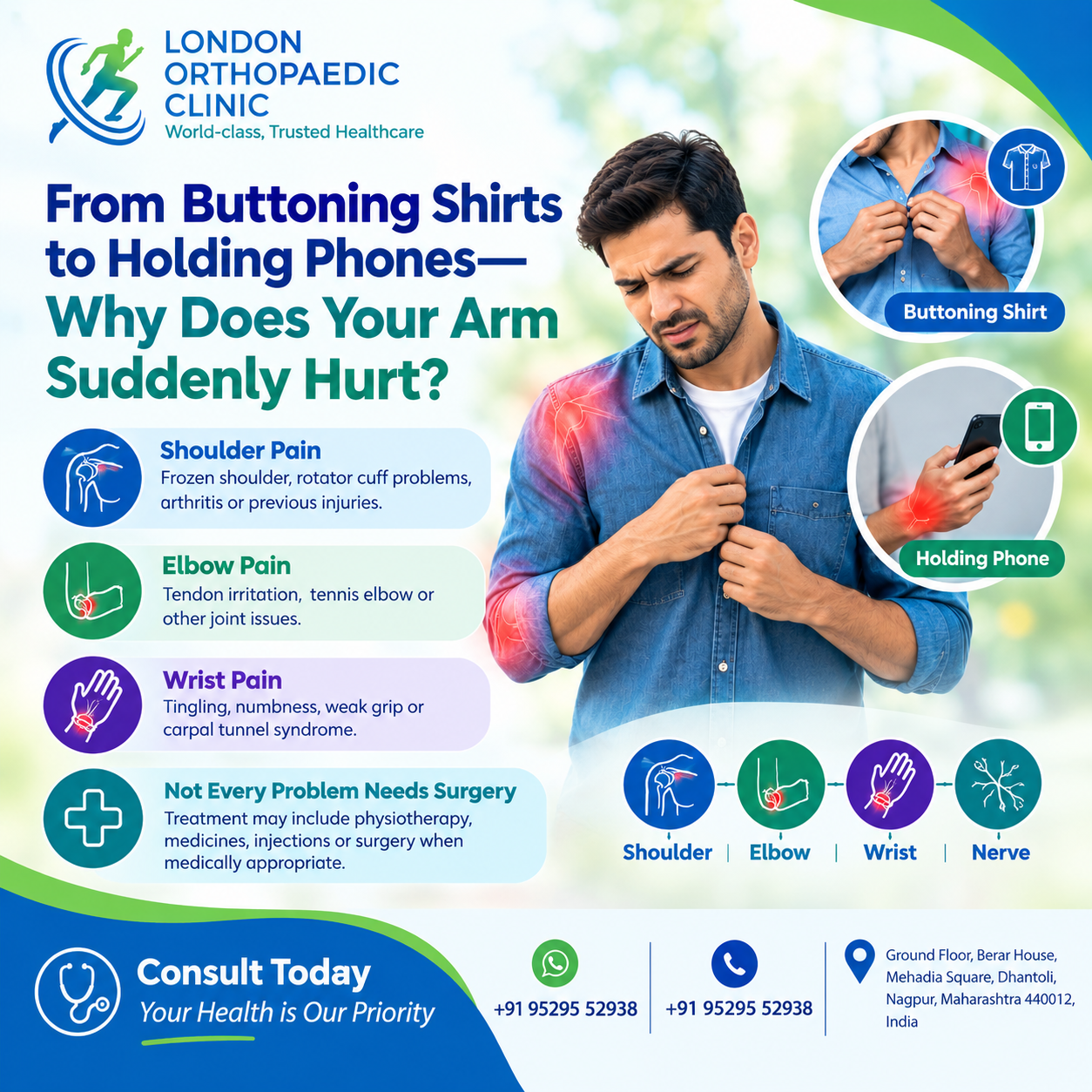
From Buttoning Shirts to Holding Phones—Why Does Your Arm Suddenly Hurt?
You may not notice your shoulder, elbow, wrist or hand when everything is working normally. You button your shirt. Pick up your phone. Comb your hair. Open a bottle. Carry a bag. Type a message. These movements seem too simple to think about. But when one day buttoning a shirt becomes difficult, holding your phone…